
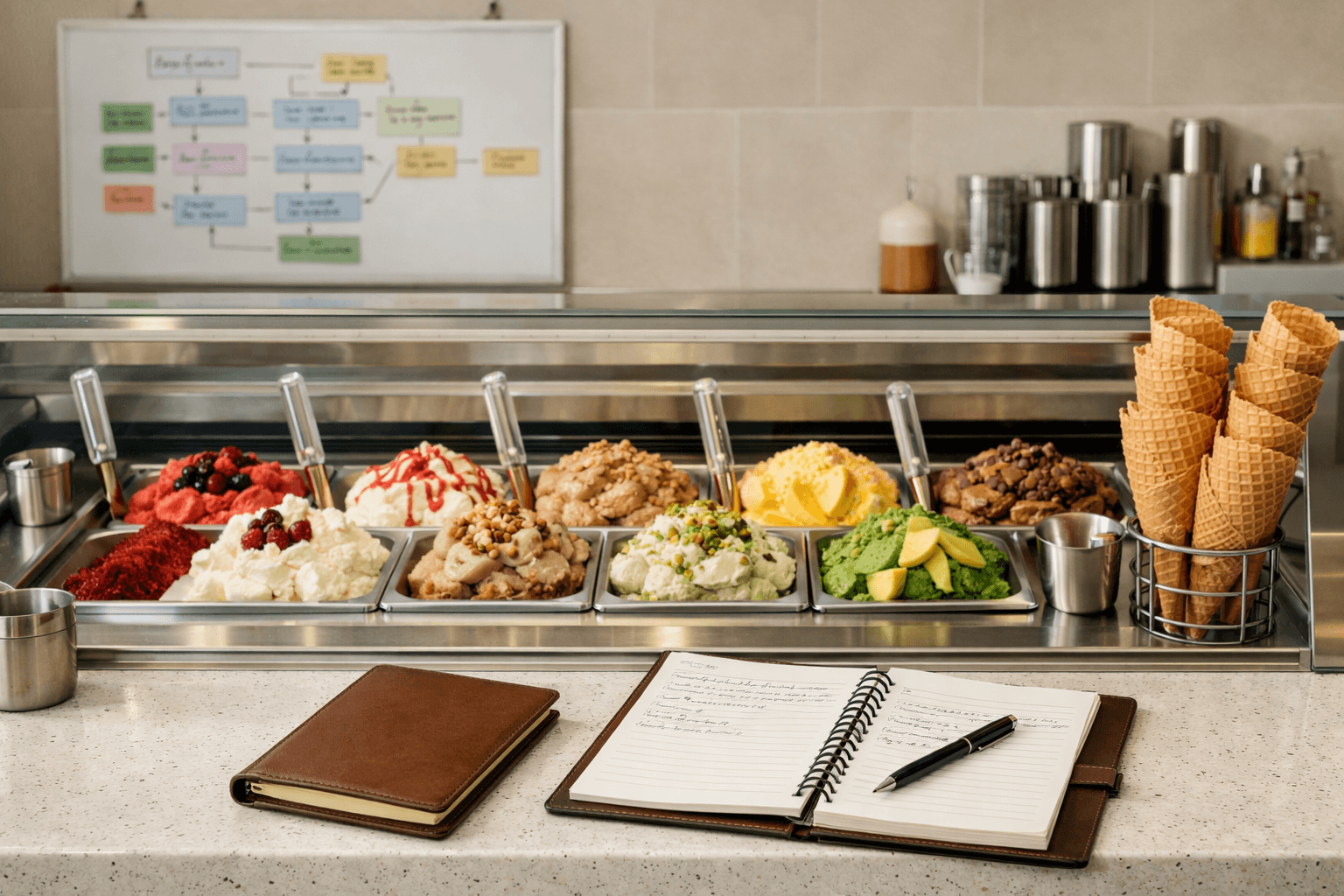
What is an SOP for an Italian Gelato counter and what problems does it solve?
SOP stands for Standard Operating Procedure, which can be understood as a set of standard operating procedures. In F&B, an SOP is like a work map: employees know what needs to be done, in what order and how to hand over tasks, instead of having to wait for the owner to remind them of each step. The reference on SOPs in food-service operations also discusses the role of procedures in helping tasks to be carried out more consistently.
For an Italian Gelato counter, the aim is not to turn employees into robots. What needs to be standardised is the repetitive work; situations that require judgement should have clear boundaries and clearly assigned responsibility. An SOP for an Italian Gelato counter, written within the right scope, can reduce dependence on the owner when the counter is busy, there are new staff members or the person in charge is absent.
If an employee takes unexpected leave, who knows what needs to be done? The procedure should provide a clear answer by specifying the person responsible, checkpoints, how to record information and what to do when the work does not meet requirements.
Define the operational scope before writing an SOP
Do not start with a lengthy document. Observe a normal working day at the counter and list the points about which employees often need to ask the owner. This is usually where a procedure creates the clearest value.
Divide activities into key periods
- Before opening: prepare the service area, equipment, ingredients and the items that need to be checked according to the counter’s actual operating model.
- During service: receive requests, introduce products, serve customers, take payment, carry out quick cleaning and replenish supplies.
- When busy: assign roles, prioritise tasks that directly affect customers and set out how to call for support.
- At the end of the shift: clean, count items using the internal form, record issues and hand over to the next shift.
- When an incident occurs: stop the relevant task, notify the person in charge and record the situation so that it can be handled consistently.
This is a guiding framework and does not replace the specific regulations of each establishment. Recipes, quantities, equipment and storage requirements must be developed according to the relevant products, premises and professional guidance; they should not be added to an SOP without confirmation.
Define responsibility boundaries
Each procedure should answer four questions: who carries it out, when is it carried out, what must be achieved and who should be notified if the requirement is not met. This way of writing helps the owner see gaps that are often concealed by personal experience.
FnB Academy provides foundational and practical knowledge about F&B business and management to support owners and professional staff in the course of operations. You can also explore the F&B Business Guide to place the SOP set within the wider operational picture.
The structure of an SOP that is easy to read and train from
An SOP used at the counter should be short, visual and linked to a specific task. If one document covers opening the shift, serving customers, cleaning, handling complaints and handover, employees will find it difficult to locate the right section during peak hours.
Suggested structure
- Procedure name: clearly state the task, such as “Opening the counter” or “End-of-shift handover”.
- Purpose: state the outcome that the procedure needs to ensure.
- Person carrying out the procedure: specify the role with primary responsibility and any supporting staff.
- Equipment and forms: list what is needed, without turning assumptions into product quantities.
- Operating steps: write them in sequence, use specific verbs and keep each step to one main action.
- Checkpoints: describe observable and recordable signs of whether the requirement has or has not been met.
- Reporting method: state who needs to be contacted and the minimum information that must be handed over.
Write it so that a new employee can follow it
Instead of writing “prepare the counter thoroughly”, break it down into checkable items: which areas need to be inspected, which equipment needs to be available and what indicates that the counter is ready. If a step depends on judgement, describe the situations in which advice should be sought rather than assuming that every case is the same.
Photos of the work area, diagrams showing equipment locations or handover forms can help employees absorb the information more quickly. However, images only support the wording; they should not be used instead of safety instructions or mandatory information.
SOP groups needed at an Italian Gelato counter
The counter does not necessarily need dozens of documents from day one. Prioritise procedures that are repeated frequently and points where mistakes could affect quality, service speed or the customer experience.
Opening and area-preparation SOP
This procedure describes how to take over a shift, check the service area, arrange equipment and confirm the necessary items before welcoming customers. The final section should include a sign-off box or a clear recording method so that the manager knows how far preparations for the shift have progressed.

The opening SOP should not become a purely cosmetic checklist. Each item should relate to an actual operational requirement, have someone responsible for it and include a way to report missing equipment or anything unusual.
Customer service and consultation SOP
The service procedure should standardise the key points of contact: greeting customers, understanding their needs, introducing suitable options, confirming the order, completing payment and thanking the customer. The wording can feel natural and reflect the brand style, but the information to be provided and the order of confirmation should be clearly defined.
For new employees, a product guide such as Baby Boss Gelato Products can be placed alongside the training materials so that employees can refer to information confirmed by the business. Employees should not be expected to make their own promises about ingredients, benefits, shelf life or storage conditions if these details are not covered by official documentation.
Cleaning and food-safety SOP
This section needs to be developed according to the equipment, premises, products and legal requirements applicable to the establishment. WHO emphasises that food safety is a shared responsibility; consumers and food handlers both have important roles in preventing foodborne disease. You can refer to WHO’s Five Keys to Safer Food.
Therefore, the SOP should clearly state which areas need cleaning, when it should be carried out, which equipment should be used, how it should be recorded and who should check it. Do not add Gelato storage periods, temperatures or cleaning quantities to the guidance without a specialised source and approval from a person with professional responsibility.
SOP for handling mistakes and customer feedback
Employees need to know when they can explain and provide support within their assigned responsibilities, when they must call a manager and how to record the incident so that the next shift does not repeat the mistake. The clearer the procedure is about “not knowing what to do”, the less often the owner will be drawn into small decisions during the day.
The aim should not be to conceal every mistake. A good system encourages early reporting, distinguishes operational errors from system errors and uses handover data to update training.
Closing and handover SOP
The end of a shift is not just about tidying the counter. Employees need to hand over completed tasks, outstanding work, items that need replenishing, notable customer feedback and any irregularities that the person in charge needs to check.
The handover form should be short enough to be completed regularly. If the form is too long, employees tend to fill it in superficially or leave sections blank, meaning that the owner still has to ask for the information verbally.
How to implement SOPs so that they are actually used
Involve employees during testing
SOP writers often view the work from a management perspective, while employees see the obstacles at the counter. Let employees try following the draft, record unclear steps, note any missing equipment and identify situations that have not been covered.
Some discussions in the F&B community suggest that recording procedures and learning how to operate from staff can make owners less dependent on personal memory. This is a reference perspective, not a standard or verified data; its main value lies in encouraging owners to observe procedures from multiple roles.
Train through demonstration and practice
Simply giving employees a document to read is not enough. The person in charge should demonstrate the process, explain the checkpoints, let employees carry it out themselves and provide feedback immediately on site. After that, a hypothetical situation can be used to check whether employees know when to ask for support.

There is no need to organise elaborate training for every minor change. For recurring errors, amend the relevant SOP section, provide guidance again at the work station and record the new version so that the whole shift uses the same document.
Check results, not just signatures
A signature confirms that an employee has completed a form, but does not prove that the procedure was carried out correctly. The manager should observe several key points, review handovers and compare customer feedback with the content of the SOP.
Each week or at an interval suitable for the counter, select several procedures for review. If a step is continually skipped, the cause may lie in the process design, the location of the equipment or the workload, rather than solely in the employee’s attitude.
Common mistakes when developing an SOP for a Gelato counter
- Writing too generally: words such as “clean”, “serve well” or “check carefully” are not enough for a new employee to act consistently.
- Turning personal experience into a rule: an owner’s habit may not be suitable for every shift or every employee.
- Combining too many tasks in one document: a lengthy SOP slows down reference and makes updating difficult.
- Not defining exceptional situations: employees may know what to do normally but become uncertain when equipment is missing, a customer provides feedback or equipment shows signs of an irregularity.
- Not assigning someone to manage the document: when no one is responsible for updating it, the SOP quickly becomes disconnected from reality.
- Including unverified information: especially quantities, safety standards, product benefits or product storage periods.
A good SOP is not the longest document; it is the document that helps employees make the right decisions within their assigned responsibilities. When the owner is absent, what needs to be controlled is clarity of responsibility, checkpoints and reporting methods—not turning every situation into a rigid script.
A framework for getting started in the first week
During the first week, choose one frequently used procedure and one procedure that often causes mistakes to trial. Have employees carry them out, record the obstacles, revise the documents and only then expand to other groups.
- Observe a shift and record the questions employees often ask.
- Select the priority procedure, identify who carries it out and define the required outcome.
- Write a short draft step by step, including checkpoints and a reporting method.
- Have employees try following it without being verbally reminded of each step.
- Revise unclear sections, approve the official version and provide further guidance.
- Schedule reviews to ensure that the document continues to match the way the counter operates.
If the counter is still in the model-preparation stage, you can also explore the Gelato ice-cream set-up consultancy service to identify the items that need to be turned into procedures. SOPs should be developed together with the actual premises and staff, not separately from them.
Frequently asked questions about SOPs for Italian Gelato counters
Does a small counter need SOPs?
Yes, but it should start with a concise set. The fewer people there are at the counter, the more easily it can become dependent on the owner’s memory; several core SOPs covering opening, service, cleaning, incident handling and handover can already provide an initial foundation.
Is an SOP a script that forces employees to do everything in exactly the same way?
Not entirely. SOPs should standardise points that affect quality, safety and responsibility, while leaving a reasonable degree of flexibility in the way employees communicate with customers.
Should recipes and quantities be included in an SOP?
They can be, if they are confirmed internal documents and are suitable for the counter’s products, equipment and professional requirements. For content without a source or approval, do not fill in quantities, storage standards or shelf life yourself.
How can you tell whether an SOP is effective?
Observe whether employees can find information independently, know whom to notify when a problem arises and whether handovers have become clearer. Combine practical observation with form reviews and customer feedback, rather than simply counting signatures.
How often should the owner update the SOP?
There is no fixed interval that is suitable for every counter. Update it whenever there are changes to products, equipment, premises or staff assignments, or when a recurring error is identified; there should also be a regular review schedule set by the person responsible.
Partner with Baby Boss
Explore products and Baby Boss services, or call 1900998880.
Shopee · TikTok · Instagram · Threads · YouTube · LinkedIn · Zalo OA · Pinterest
Comments