
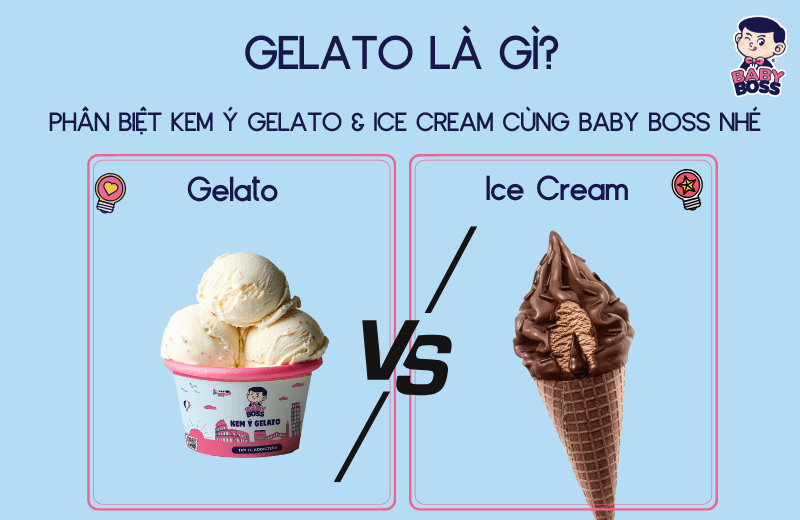
What Is Gelato? Distinguishing Italian Gelato from Ice Cream [The Complete Guide from Experts]
You step into an elegant gelato shop, look at the glass display cabinet showcasing colourful, intricately decorated mounds of gelato and wonder: "Gelato is it just a fancy Italian word for 'ice cream'?". This is a question many people ask. And the definitive answer is: Absolutely not.
If ice cream (industrial ice cream) is an upbeat, easy-listening pop song, then Italian gelato is a classical symphony, full of depth, sophistication and requiring expertise. It is not merely a dessert; it is a cultural heritage and a culinary art that Italians have elevated over many centuries.
So what has made Italian gelato a globally renowned speciality? Where is the invisible yet remarkably clear line between a smooth, rich scoop of gelato and a scoop of ordinary ice cream? This article will be a detailed map, guiding you into the captivating world of Italian gelato, decoding every secret from A to Z and helping you become a discerning connoisseur.
Italian gelato is an Italian-style artisanal ice cream made from milk, sugar and natural ingredients. The key differences compared with ice cream (industrial ice cream) lie in 3 factors: (1) Less fat (0-8% compared with 15-18%), making the flavours more authentic; (2) Less air (25-30% compared with >50%), creating a dense, elastic texture and rich flavour; and (3) A warmer serving temperature, allowing the palate to fully appreciate the flavours without brain freeze.

What Is Gelato? The Timeless Journey of a Culinary Icon
The word "Gelato" originates from the Italian word “gelare”, meaning “to freeze”. In Vietnam, it is commonly called "Italian ice cream" to clearly indicate its origin and distinctive preparation style. But Gelato is not merely a food; it is a story of history.
Origins in Royal Banquets
Although early forms of frozen desserts existed in ancient times, Italian gelato as we know it today is believed to have emerged during the Renaissance in Italy. It was not street food, but a luxurious dessert reserved for the aristocracy and royalty. The artisans of the time continuously innovated to create unique flavours for lavish banquets, and the recipes were regarded as state secrets.
The "Heart" of Italian Gelato: A Delicate Chemical Balance
From a scientific perspective, a perfect scoop of Italian gelato is a feat of balance. It is a smooth product that exists in all three states of matter—solid, liquid and gas—formed by the combination of 3 core elements:
WATER: Making up most of the composition, water (from milk and fruit) is "absorbed" by the solids, preventing it from turning into large ice crystals.
SUGAR: Sugar does more than add sweetness. It is a skilled "architect", helping to keep the water crystals small, binding the structure together tightly and giving Italian gelato
its characteristic soft, smooth texture. AIR:
Introduced in a controlled manner during the slow freezing process, air is the element that gives the product its light, delicate softness. The complexity of balancing these elements when combined with countless other ingredients (milk, fresh cream, eggs, fruit, nuts...) provides fertile ground for the continual creativity of

Italian gelato
artisans. The Classic Showdown: Distinguishing Italian Gelato from Ice Cream This is the most important part of becoming a true connoisseur. Place a glass of
Italian gelato
and a glass of ice cream side by side, and you will notice differences not only in flavour but also in appearance and mouthfeel.
1. Fat Content: The Battle of the PalateIce Cream: Under international standards, industrial ice cream must contain at least 10% fat, while premium ice cream varieties typically contain 15% to 18% fat or more. This fat mainly comes from heavy cream. Italian Gelato : In contrast,
Italian gelato has a much lower fat content, ranging from just 0-8%. Traditional recipes use more whole fresh milk and less fresh cream. Why Does This Matter? Fat tends to coat your palate. With a high fat content, ice cream usually feels rich and creamy, and can sometimes be slightly "heavy". This fatty coating inadvertently reduces your ability to perceive other flavours. Conversely, with less fat, your palate feels "cleaner", allowing the true flavours of strawberry, chocolate, hazelnut... to burst through with the greatest authenticity and intensity. That is why when you eat a scoop of
Italian gelato
passion fruit flavour, you feel as though you are eating a real passion fruit.
2. Air Content (Overrun): The Battle of DensityIce Cream: Industrial ice cream is made using a high-speed freezing machine that whips the mixture to incorporate a great deal of air. This air (known as "overrun") can account for from 50% to more than 90% of the volume. In other words, when you buy a 1-litre tub of ice cream, you may only be buying 0.5 litres of actual product; the rest is air. This makes the ice cream light and fluffy while reducing production costs. Italian Gelato : The process of making gelato specially designed to churn at low speed, introducing a minimal amount of air, just 25-30%.
Why Is This Important? Less air means that each scoop of Italian gelato is much denser, chewier and richer in flavour. Every spoonful contains more "substance". This is what creates its distinctive smooth, dense and chewy texture, completely different from the light, airy texture and rapid melting of industrial ice cream.
3. Serving Temperature: The Battle of the Senses
Ice Cream: Industrial ice cream is usually stored and served at very low temperatures, around -22°C to -18°C. At this temperature, the ice cream is hard as ice, allowing it to be transported and stored for longer.
Italian Gelato: Italian gelato is served at a considerably "warmer" temperature, around -14°C to -12°C.
Why Is This Important? The warmer temperature offers two wonderful benefits. First, it helps the texture of Italian gelato remain soft and smoothly chewy, making it easy to scoop with a specialist spatula without using force. Second, and more importantly, an environment that is not too cold will not numb your taste buds. You can immediately enjoy the full complexity of its layers of flavour without the unpleasant feeling of "brain freeze".

Artisan Style Gelato - The Philosophy Behind Every Scoop at Baby Boss
"Artisan" means "handcrafted". When we talk about Italian gelato made by hand, we are talking about a philosophy and an absolute respect for the ingredients and the process. This is the philosophy that Baby Boss follows.
What Is Genuine Artisan Italian Gelato?
An artisan who makes Italian gelato is like a chef in a fine-dining restaurant. They do not produce on a mass scale. They work in small batches, sensing every seasonal change in the ingredients and constantly creating. Each recipe is unique. If you visit 10 different artisan gelato shops, you will taste 10 different chocolate flavours. That is the individual mark, the "signature", of the artisan.
The Gold Standard of Artisan Italian Gelato - Baby Boss's Commitment
INGREDIENTS: Only the highest-quality ingredients are used. Fresh pasteurised milk each day, carefully selected seasonal fresh fruit, and nuts and chocolate imported from renowned regions. Always fresh.
PRODUCTION: Handcrafted in small batches each day at our own facility. We do not keep products frozen for months on end.
GELATO: Every scoop of Italian gelato you enjoy is a fresh product, made to an exclusive recipe researched and developed by the Baby Boss.
FLAVOUR: Varied, rich and authentic. Absolutely no preservatives or artificial flavourings are used.
ADVERTISING: Quality is the only factor we emphasise. The customer experience is the best advertisement.
Quick Frequently Asked Questions (FAQ) About Italian Gelato
1. Is Italian gelato healthier than ice cream?
Generally speaking, yes. As it has a significantly lower fat content and is made from natural ingredients, Italian gelato is often a "lighter" and healthier choice. However, it still contains sugar, so please enjoy it in moderation.
2. Why is Italian gelato usually more expensive than industrial ice cream?
There are 3 main reasons: (1) High-quality ingredients: The cost of fresh fruit, imported nuts... is much higher than that of flavourings. (2) Handcrafted process: Producing in small batches takes more time and effort. (3) Less air: You are paying for the actual product, not air.
3. What types of gelato are there?
There are two main forms: Gelato traditional gelato (milk-based and creamy) and Sorbetto (or Sorbet, water-based and dairy-free, usually made from fruit and suitable for vegans).
Now, you not only know what Italian gelato is, but you also understand the spirit and essence behind it. The next time you stand in front of a gelato counter, feel confident like an expert.
But reading alone is not enough. The best way to understand the difference is to experience it. We warmly invite you to visit Baby Boss shops in Hanoi, Ho Chi Minh City and across the country to experience the difference in every spoonful of Italian gelato smooth, rich in flavour. Come and let your taste buds tell you the rest of the story.
Receive a free gelato sample and business partnership consultation with Baby Boss


Baby Boss is committed to delivering the best value to our customers!
Comments