
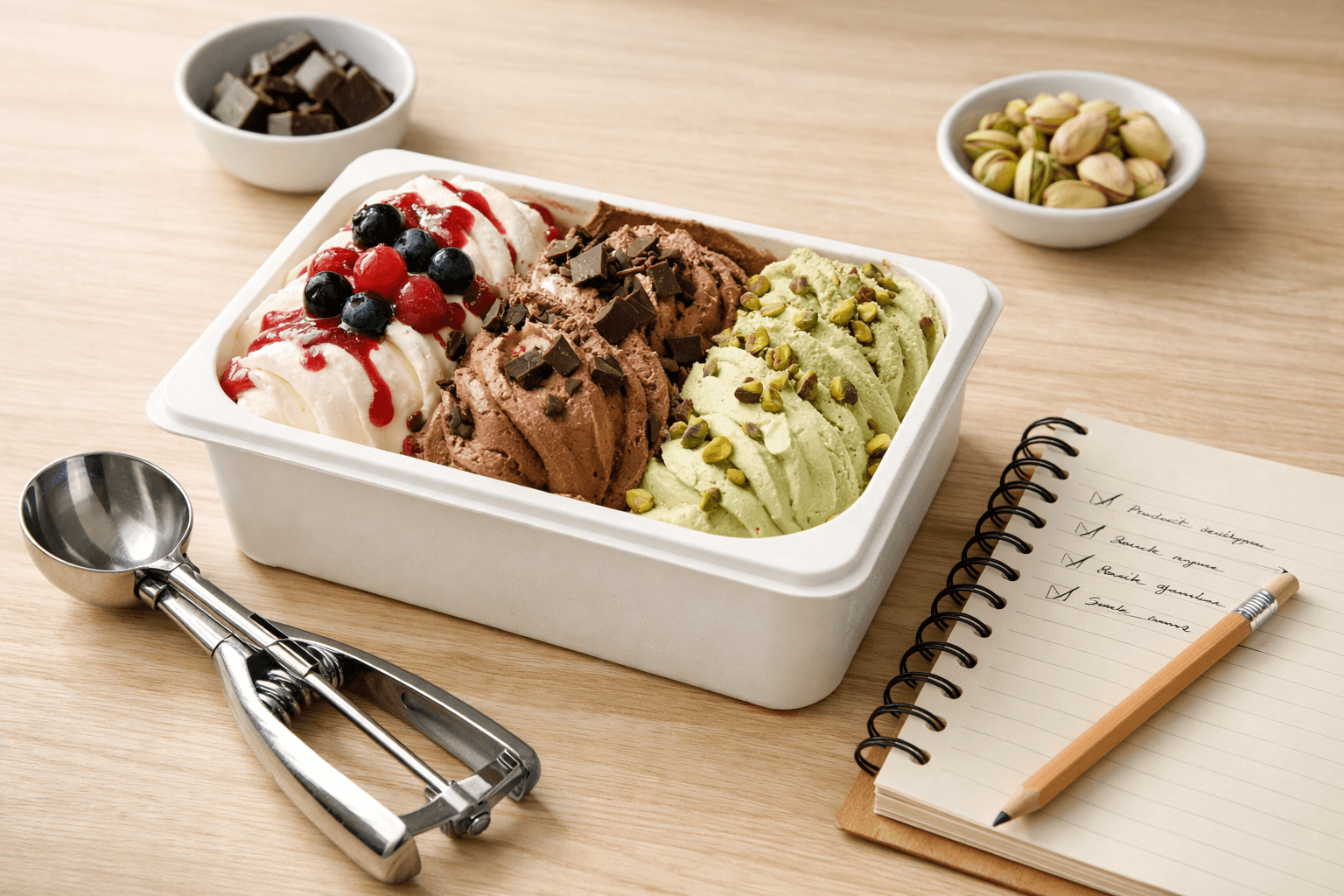
Market signals are creating more room for ice cream contract manufacturing
The Vietnamese dairy and dairy products market is being driven by a large population and rising average incomes. According to the report by the Import-Export Department, domestic consumer demand is expanding, while higher-value product groups such as dairy ice cream, cheese, whey products and organic milk have recorded steady growth in import turnover.
This is a foundational signal for brands considering developing their own ice cream products or exploring ice cream contract manufacturing. However, it should be made clear that the above data reflects the dairy and dairy products market in general, not the direct size or growth rate of the ice cream contract manufacturing industry.
Premiumisation is not simply about raising prices
A secondary analysis of the Vietnamese ice cream market suggests that product portfolios may gradually shift towards formats that create higher value, including chocolate-coated ice lollies, multipacks, low-sugar products, dairy-free formulations and artisanal gelato. The source also forecasts that the takeaway channel will contribute more to value alongside the immediate-consumption product group, which remains a commercial pillar of the industry.
For brands, premiumisation should therefore not be understood simply as using more expensive packaging or setting a higher price. The practical question is whether the partner can develop a formulation, scale it up to production and maintain consistency between batches; these capabilities need to be checked directly during discussions about ice cream contract manufacturing.
Three product directions worth considering
| Product direction | Commercial significance mentioned by the source | Points to verify when outsourcing production |
|---|---|---|
| Immediate-consumption products | Continue to play an important commercial role. | Format, distribution capability and suitability for the sales channel. |
| Take-home products | May increase their contribution to industry value. | Packaging specifications, cold distribution conditions and consumption plan. |
| Higher-value formulations | Include directions such as coated ice cream, multipacks, low-sugar, dairy-free or artisanal gelato. | Formulation development capability, ingredients and production stability. |
The table above is an interpretation of the direction indicated by the market analysis, not a mandatory product list or a guarantee of business performance. SKU selection should still be based on the target customer, expected selling price, distribution channel and the capabilities of the ice cream contract manufacturing partner.
What should brand owners ask when looking for an ice cream contract manufacturing partner?
In communities for product developers and business owners, newcomers commonly ask whether a trial formulation can be scaled up to large-scale production, as well as about minimum quantities, packaging and lead times. These are community perspectives, not survey data; nevertheless, they suggest a useful list of questions to consider before signing an ice cream contract manufacturing agreement.

1. Formulation development and transfer capability
The brand should clarify whether the partner supports the development of new formulations or mainly produces according to existing formulations. The process for sample trials, evaluation criteria, formulation ownership and the approach to handling a trial product that does not meet requirements should also be agreed.
2. Production scale and minimum quantities
Minimum quantities directly affect stock investment, launch planning and the ability to test the market. A standard MOQ should not be assumed for every provider; the brand should request quotations and specific terms based on the format, formulation, packaging and expected production volume.
3. Portfolio and distribution channels
The market analysis source notes that domestic manufacturers have advantages in low-cost distribution and developing flavours suited to local preferences, while imported brands may compete more effectively in premium supermarkets, hotels, restaurants and specialist dessert outlets. This is a market-level observation, not a commitment from every contract manufacturer.
Therefore, the brand needs to place the product in the right channel from the outset: immediate consumption, takeaway, specialist shops or retail systems. You can also refer to the F&B Business Guide to structure the product, customer and sales-channel considerations.
Ice cream contract manufacturing must be considered alongside quality
Contract manufacturing is not simply ordering a product according to a sample. It is a process involving coordination between the formulation, ingredients, equipment, batch size, packaging and distribution plan; each factor can affect product consistency.
For ready-to-eat foods, risk control should also be discussed clearly with the manufacturer. FAO and WHO have assessed the risk of Listeria monocytogenes in various ready-to-eat food groups, including ice cream and frozen dairy products; this source does not provide a general shelf life for all products, so the period of use should not be inferred from a market article.

The brand should ask the partner to provide appropriate information about control procedures, product documentation, storage conditions and usage instructions for each product. These points must be confirmed through technical documentation and applicable legal requirements, and cannot be replaced by community opinions.
What does the ice cream market data say — and what does it not say?
Ken Research’s secondary analysis forecasts the value of the Vietnamese ice cream market to increase from USD 276 million in 2025 to USD 423.4 million in 2031, with a forecast compound growth rate of 7.39%. This is a forecast from a secondary source, not official statistical data, and it does not directly measure the revenue of ice cream contract manufacturing providers.
| What can be taken as a reference | What cannot yet be concluded |
|---|---|
| Demand for and the value of the ice cream portfolio may expand; premium formats may contribute more to value. | The size of the ice cream contract manufacturing industry in Vietnam or the market share of each contract manufacturer. |
| The immediate-consumption channel remains important, while take-home products are forecast to increase their contribution. | That a specific formulation, packaging format or SKU will definitely succeed. |
| Domestic manufacturers are considered to have advantages in distribution and local flavours. | The capacity, MOQ, contract manufacturing price or delivery time of a specific provider. |
This distinction helps brands avoid turning an industry forecast into a business promise. For businesses looking for a partner, the next step should be to compare their product objectives with actual capabilities through samples, technical documentation and a production plan.
Conclusion: The opportunity lies in the ability to turn ideas into products
Signals from the dairy, dairy products and ice cream markets give brands more reason to consider higher-value product portfolios. However, the opportunity for premiumisation only becomes a viable plan when supported by a suitable formulation, a clear production scale, a specific sales channel and a verified control process.
If you are exploring Gelato contract manufacturing, you can also view Gelato Pro ice cream to browse the portfolio and discuss your requirements with Baby Boss. Product information, partnership terms and the ability to develop according to requirements need to be advised on separately for each project.
Partner with Baby Boss
Explore products and Baby Boss services, or call 1900998880.
Shopee · TikTok · Instagram · Threads · YouTube · LinkedIn · Zalo OA · Pinterest
Comments