
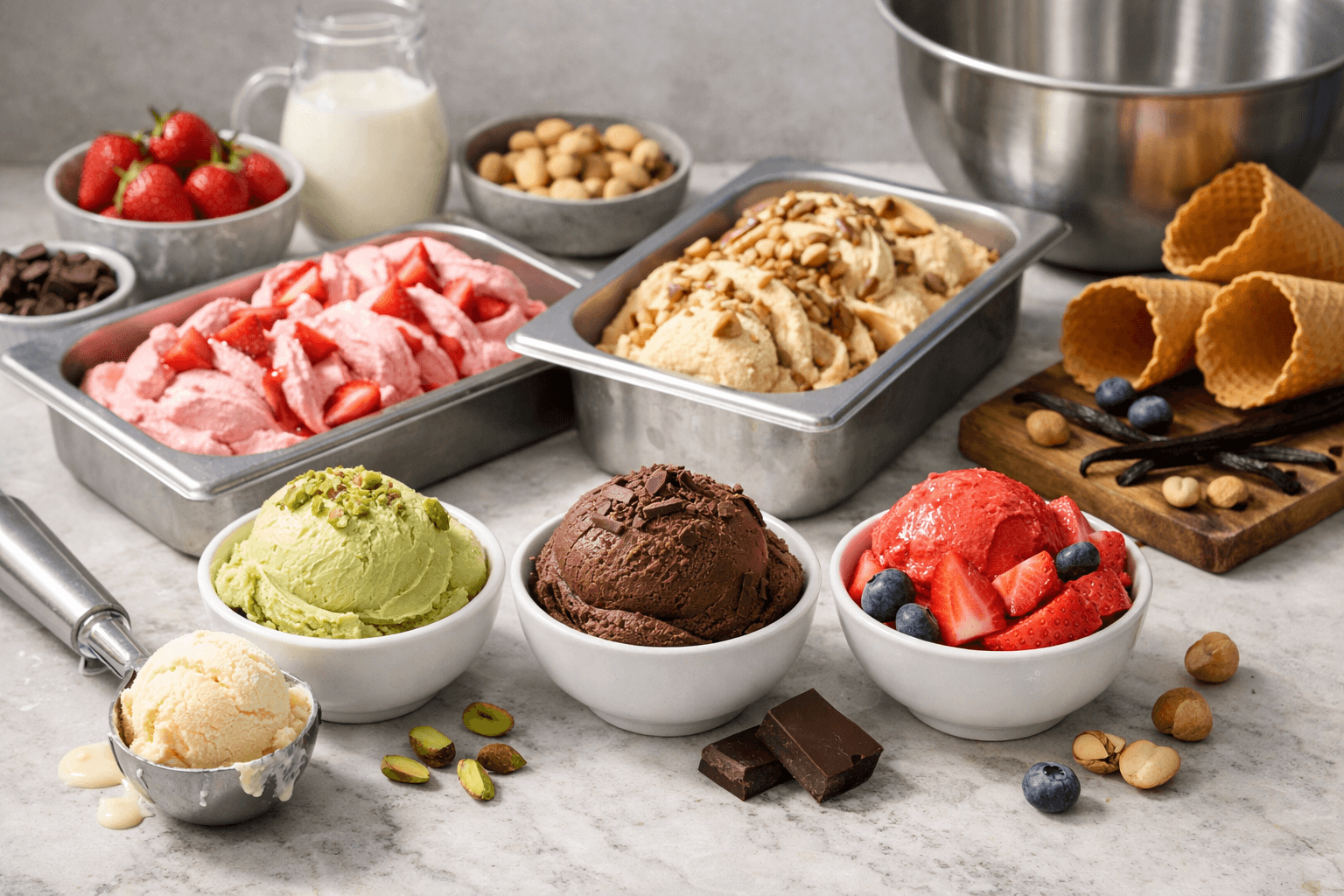
What opportunities are emerging in the Vietnamese ice cream market?
Gelato contract manufacturing may suit brands that want to focus on positioning, sales channels and customer experience rather than building the entire production capability themselves. To choose the right direction, brands should first define the segment, sales channel, product format and operational capabilities required.
The Vietnamese ice cream market is being shaped by two parallel drivers: regular consumer demand through quick-purchase channels and the expansion of higher-value products. According to forecasts by Ken Research, Vietnam's ice cream market could grow from USD 276.0 million in 2025 to USD 423.4 million by 2031, corresponding to a forecast CAGR of 7.39%.
This data does not mean that every gelato brand will grow in the same way. Opportunities also depend on the sales location, cold-storage capability, SKU turnover rate, price level and how clearly the brand creates a reason to buy.
Notably, market value is forecast to grow faster than volume as premium lines, multipacks, low-sugar products, imported pints and artisan gelato gradually improve the category mix, according to the same forecast from Ken Research. This is a signal for brands to consider not only selling more, but also selling the right format to the right customer group.
Why are brands interested in gelato contract manufacturing?
For shop owners or new brands, building the entire production capability themselves can raise many questions about equipment, capacity, recipes, cost of goods, inventory and transport. By choosing gelato contract manufacturing in Vietnam, brands can focus more on positioning, sales channels and customer experience, while working with a partner on production.
Contract manufacturing does not eliminate all risks; it shifts the focus to choosing the right capabilities, coordination standards and supply model. Brands should therefore assess the product format, capacity, cold delivery and collection, and cost structure before making a commitment.
The point to determine first is not “whether to use contract manufacturing”, but which channel, customer group and product range it is intended to serve.

Four product directions worth considering
A report on the Vietnamese gelato market by 6Wresearch lists the analysis groups as classic gelato, artisan gelato, vegan gelato and seasonal flavors. However, the information provided only describes the report's classification structure and is not sufficient to conclude which group is leading or has the largest scale.
Brands should therefore view the groups below as directions requiring assessment, rather than a list of guaranteed winning trends.
| Product direction | Worth considering when | Questions to check |
|---|---|---|
| Classic gelato | The brand wants to build a range that is easy to understand and introduce | Which core flavours will create recognition? Is the price level suitable for the sales location? |
| Artisan or premium gelato | The sales location focuses on experience and value per serving | Are customers willing to accept a higher price? Is the product story clear enough? |
| Vegan or dairy-free gelato | The brand wants to test a specialised need | Have the customer-base size, ingredients, published information and operational requirements been verified? |
| Seasonal flavours | The brand can refresh its communications and range | What are the launch timing, minimum production volume and plan for dealing with leftover stock? |
Note: the groups above are used to guide business questions. The source provided does not contain sufficient data to confirm the demand, revenue or individual growth rate of each group.
Choose the sales channel before choosing the product
Ken Research describes Vietnam's ice cream industry as having a frequent quick-purchase channel and a smaller take-home channel; industry value is influenced by the coverage of sales locations, the availability of freezers, SKU turnover rate and accessible price levels. This shows that the same gelato product will be developed differently depending on whether it is sold in a specialist shop, restaurant, café or for takeaway.
Gelato shops and speciality stores
This channel suits brands investing in experience, flavour storytelling and presentation. The important challenge is to have a range that is attractive enough without being too broad for the customer traffic and operational capability at the sales location.
Restaurants, cafés and foodservice
For foodservice, products need to support a consistent serving process and be easy to coordinate with the existing menu. Brands should clarify delivery and collection specifications, replenishment frequency, demand forecasting and the responsibilities of the ordering party and the contract manufacturer.

Retail and takeaway
Retail requires brands to consider packaging, volume, selling price, freezer coverage and turnover rate. Meanwhile, takeaway or online models require more careful assessment of the cold-delivery area and the product experience after transport; the source provided does not specify storage duration or transport conditions, so these parameters should not be assumed.
Criteria for choosing a gelato contract manufacturing partner
When looking for a gelato contract manufacturing partner, brands should not ask only about the price per kilogram or per tub. An effective discussion should place the product within the entire operational chain, from sampling to regular production and handling changes in demand.
- Capability by sales channel: can the partner meet specifications suitable for shops, restaurants, retail or takeaway?
- Ability to develop the range: how will the sampling, flavour adjustment and launch of new SKUs be coordinated?
- Capacity and expansion plans: minimum production volume, ordering schedules and the ability to increase production should be clarified before making a commitment.
- Cold-chain operations: both parties need to agree on delivery and collection, the handover point and responsibility for control during transport.
- Cost transparency: in addition to the manufacturing fee, related costs for packaging, transport, sampling, storage and activities at the sales location, where applicable, should be included.
- Brand positioning: will the contract-manufactured product help the brand differentiate itself, or simply add another SKU similar to the many other choices on the market?
These questions can be used as an initial checklist when exploring Gelato manufacturing contract services. If the brand has not finalised its range, reading more about the F&B business guide may also help organise the issue by business model and sales channel.
Which direction should brands start with?
There is no single option that suits every brand. A café needs products that are easy to pair with drinks and desserts; a specialist gelato shop needs to prioritise experience and range; while a retail brand must pay more attention to format, price and cold-distribution capability.
A cautious approach is to start with a focused range, clearly define the sales channel, test real-world feedback and only then expand. Before deciding, brands can explore Gelato knowledge and compare product options in the Baby Boss Gelato range to gain a clearer picture of the direction to take.
The market is forecast to retain room for growth, but growth does not automatically translate into business effectiveness. With gelato contract manufacturing, the advantage will lie in connecting the right product to the right channel, controlling operations and creating an experience distinctive enough to bring customers back.
Partner with Baby Boss
Explore products and Baby Boss services, or call 1900998880.
Shopee · TikTok · Instagram · Threads · YouTube · LinkedIn · Zalo OA · Pinterest
Comments