
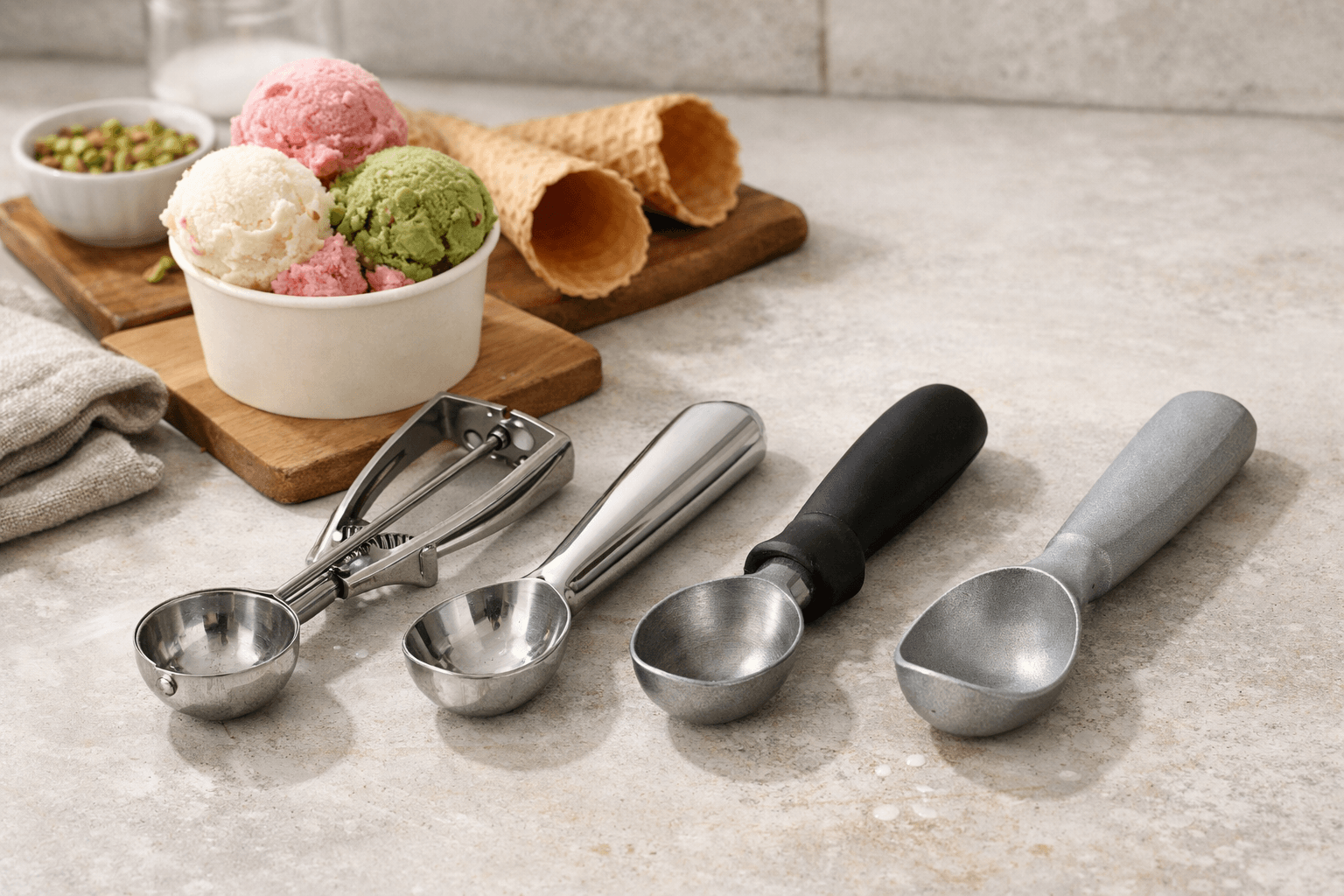
Common types of ice cream scoops
Ice cream scoops on the market come in many different shapes and handle designs. Product names do not always clearly indicate the construction, durability or feel of each model.
An easier approach is to classify these tools by observable features such as the scoop bowl, release mechanism, material, handle and scale of use. This article focuses on how to identify and choose the right tool and does not replace Gelato Knowledge about scooping technique.
Updated: March 2025. Information that depends on a specific product should be checked against the manufacturer's instructions at the time of purchase.
Basic round-bowl scoops
This group has a bowl-shaped scoop and is often the first type people think of when looking for an ice cream scoop. This design suits those who want a simple tool that is easy to understand and has few additional components.
When examining a specific model, look at the depth of the scoop bowl, the overall size and how it feels to hold. These factors may affect the process of forming a scoop of ice cream, but the currently approved sources do not contain verified data for ranking the effectiveness of different designs.
Scoops with levers or release mechanisms
Some models include a lever inside the scoop bowl to help release the ice cream from the tool. This is a difference in construction, but you should not assume that every release mechanism offers the same feel or durability.
If you choose this type, check whether the lever moves smoothly, whether it feels loose in the hand and whether the contact points are easy to clean. Service life, suitability for hard ice cream and dishwasher cleaning should be confirmed using the technical information provided by each manufacturer.
Claw-style scoops or portioning tools
This group is often considered when users want relatively even portions or faster operation. However, the scoop size and operating method can differ significantly between models.
For home use, convenience may be more important than absolute consistency. For a gelato counter, you should also consider service pace, how the tool feels when used repeatedly and how it is positioned in the work area.
Comparing shape, material and handle
No single type of ice cream scoop is suitable for every situation. The table below provides a framework for asking the right questions when viewing a product; it is not a quality ranking of different brands.
| Criteria | What to look at | Questions to ask |
|---|---|---|
| Shape | Round bowl, deep bowl, lever or another mechanism | Is the design suitable for the portion size and serving method you expect to use? |
| Material | Material information published by the manufacturer | Is the material clearly described, and are the surfaces easy to inspect and clean? |
| Handle | Length, shape, grip and perceived weight | Does it feel comfortable when held and used continuously? |
| Movement mechanism | Lever, spring or release component, if present | Does this component operate consistently and remain easy to clean? |
| Size | Scoop-bowl diameter and overall length | Is the size suitable for your cups, cones or serving portions? |
Material: do not look only at the name
Many first-time buyers ask, “Is stainless steel or aluminium better?” The answer should not be based solely on the material name, because the practical experience also depends on the finish, handle design, movement mechanism and care instructions for each product.

Prioritise models with clear material information, surfaces that are easy to inspect and no concealed areas that are difficult to check. If the seller does not specify cleaning instructions or usage limitations, treat this as missing information rather than making assumptions.
Handles and handling comfort
In kitchen equipment and F&B groups, people often discuss how well a tool fits the hand, its weight and how tiring it feels during prolonged use. This community perspective can help you understand what to try, but it is not evidence that a design is always durable or suitable for everyone.
If possible, hold the tool before buying it. Check whether the handle is slippery, whether the edges feel uncomfortable and whether your fingers touch the movement mechanism during use.
Durability and long-term use
Durability is a frequently raised concern, especially when buying tools for a counter. However, the approved sources for this article do not provide tests, usage periods, comparative data or conclusions about the durability of each type of ice cream scoop.
Instead of relying on general promotional claims, check the warranty information, joint construction, handle strength and care instructions. For a business model, you can refer to the F&B Business Guide to place tool selection within the wider operating process.
Choosing an ice cream scoop according to your needs
For home use
Household use usually prioritises tools that are easy to hold, store and check after use. A model with a moderate construction and few hard-to-clean details may be an easy option to start with, but you should still check the manufacturer's instructions.
- Choose a size that suits the cups or cones you commonly use.
- Prioritise a handle that feels secure and does not cause discomfort when held.
- Check the cleaning method carefully before buying.
- Do not assume that the product is dishwasher-safe unless this has been confirmed in the instructions.
For a gelato counter or shop
At a counter, ice cream scoops for a gelato counter should be considered part of the serving process rather than simply an accessory. In addition to the desired scoop shape, consider operating speed, consistency between staff members and how the tool is positioned after each use.
If you are preparing a business model, you can refer to Gelato Setup Consultation to connect tool selection with the space and operating process. Specific hygiene requirements must be developed according to the establishment's procedures and the product instructions.
For sampling or serving different portion sizes
If you need to serve different portion sizes, compare the scoop-bowl sizes rather than looking only at the external shape. A smaller model may be considered for samples, while a larger model may suit a standard serving; however, the specific size should be determined by the operator according to the menu.
You should not infer a portion size or number of grams for each type of scoop if the product does not publish specifications and the establishment has not carried out practical checks. Serving portions should be standardised through testing under real operating conditions.

Cleaning and points to confirm
In the approved FAO source, GMP is described as the basic requirements of good manufacturing practice; see the definition of GMP in the FAO document. However, this source does not provide specific guidance for evaluating individual ice cream scoops and does not confirm that any particular model is dishwasher-safe.
Therefore, distinguish between the establishment's hygienic operating principles and the product's technical claims. Before buying, ask or check:
- How is the material that comes into contact with food described?
- Does the product have removable parts or gaps that are difficult to clean?
- Does the manufacturer instruct users to wash it by hand or allow dishwasher use?
- How are drying and storage after cleaning described?
Do not turn hearsay or personal experience into conclusions about food safety, service life or durability. These matters require technical documents, the establishment's procedures or an appropriate accepted source.
Frequently asked questions when choosing an ice cream scoop
What is the best type of ice cream scoop?
There is no single best type for every need. Choose according to the serving method, portion size, feel in the hand, construction and cleaning instructions for the specific product.
Should I choose an ice cream scoop with a lever or a simple type?
A scoop with a lever has an additional movement mechanism, while a simple type has fewer components. Consider convenience, ease of cleaning and the manufacturer's instructions rather than assuming that one type is always better.
Can a stainless steel ice cream scoop be used for a long time?
The approved sources contain no comparative data on the durability of different materials or the service life of stainless steel ice cream scoops. Check the material information, joints, warranty and care instructions for each product.
Can an ice cream scoop be put in the dishwasher?
Only do so when the manufacturer has clearly confirmed that it is suitable. This article does not have sufficient sources to conclude generally that all types of ice cream scoop are dishwasher-safe.
What size ice cream scoop should I buy for a gelato counter?
Base your choice on the serving portion, the type of cup or cone and the counter's serving process. Do not infer a specific portion size without product specifications and practical testing.
Checklist for buying different types of ice cream scoops
- Identify where the tool will be used: at home, at a gelato counter, for samples or for different portion sizes.
- Choose the shape based on the intended serving method, not just the image.
- Check the material information and cleaning instructions for the specific product.
- Hold it to assess the handle, weight and edges that come into contact with your hand.
- Check the lever or release mechanism if the product has moving parts.
- Ask about the warranty policy and usage limitations before buying in large quantities.
If you are developing a menu or looking for a source of gelato products, you can also view Baby Boss Gelato Products to explore a range suited to your business direction. Tools should be selected after clearly defining the shop's serving portions, space and operating process.
Scope and references
The FAO source was used to cross-check how GMP is described in the approved document; it is not a document for evaluating the material, durability or effectiveness of ice cream scoops. The approved WebstaurantStore source discusses types of ice cream cones and does not provide direct data for ranking different types of ice cream scoops. Therefore, the observations about classification and selection criteria in this article are presented as a reference framework or practical inference, not as conclusions from testing between products.
References
Partner with Baby Boss
Explore our products and Baby Boss services, or call 1900998880.
Shopee · TikTok · Instagram · Threads · YouTube · LinkedIn · Zalo OA · Pinterest
Comments