
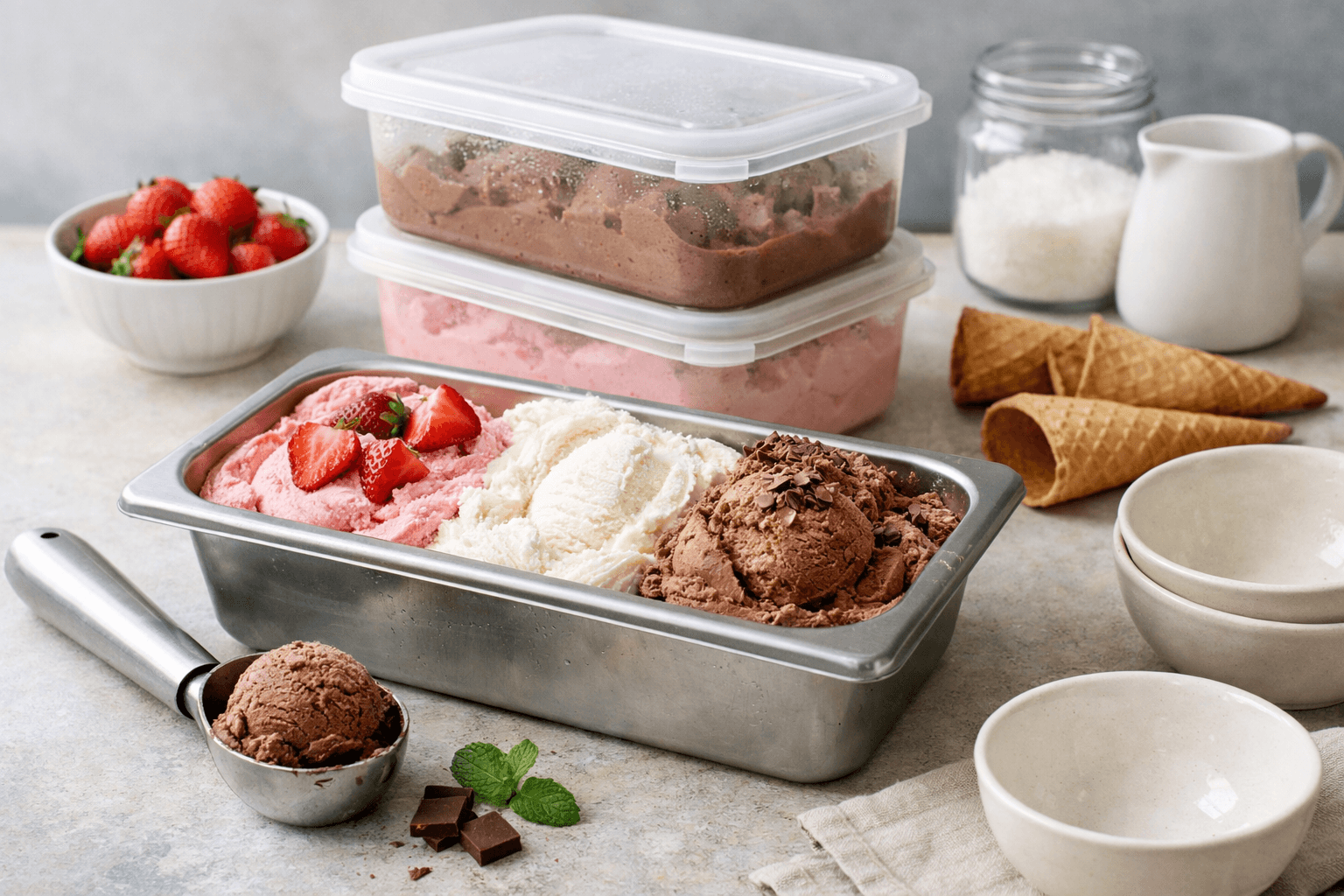
How to store gelato at home: start by keeping it chilled promptly
Gelato is often bought to eat straight away or take home for later. However, the question “how should gelato be stored at home?” should not be answered simply with a fixed number of days. The storage period and conditions also depend on the instructions on the label, the type of product and the manufacturer's guidance.
For people buying gelato to take home in Vietnam and storing it in a domestic refrigerator or freezer, the practical principle is: put the gelato into a cold-storage appliance as soon as possible, limit the time it spends at room temperature, keep the tub tightly closed and check the product before eating. This is also the foundation of storing gelato safely at home in a way that is suitable for each product. FDA recommends that foods requiring refrigeration should be placed in a refrigerator or freezer immediately after being brought home; keeping food at an appropriate temperature can help prevent or slow the growth of certain bacteria.
Storage instructions and information on the label may be updated from time to time. Therefore, when using gelato you already have, give priority to the current instructions on the packaging and the manufacturer's direct guidance.
1. How should gelato be handled after bringing it home?
Put gelato somewhere cold promptly
If you are not eating it straight away, prioritise putting the product in the appropriate storage compartment according to the instructions on the label. Do not leave the tub on the kitchen worktop, in a shopping bag or in the boot of a car for longer than necessary.
A simple process at home:
- Quickly check the gelato tub and the storage instructions on the label.
- Put the product in the refrigerator or freezer according to the manufacturer's instructions.
- Place the tub in a stable position, away from foods that could knock it over or soil the lid.
- After taking out the gelato, close the lid immediately and return the remainder to cold storage.
If the product requires refrigeration but has been left at room temperature for a significant period, be cautious rather than relying only on your senses. FDA states the “two-hour rule” for foods requiring refrigeration when left at room temperature; this period is shorter when the air temperature is above 90°F, equivalent to approximately 32°C. This is general food-safety guidance, not a specific shelf life for every type of gelato.
Keep the tub closed
Close the lid tightly after each time you take out gelato. FDA guidance also recommends keeping food covered or storing it in a sealed container or sealed storage bag.
With gelato, closing the tub immediately helps limit unnecessary exposure to the air and surrounding environment. If the lid is loose, the tub is cracked or the gelato has come into contact with other food in the freezer, carefully assess the condition of the product before using it.
Limit how often you open the tub
Each time the tub is opened, the gelato is exposed to the outside environment. Therefore, you can portion it out before eating, use a clean spoon and close the lid immediately after taking the amount you need. This is a practical way to limit the time the tub remains open; however, it cannot replace the storage instructions on the label or extend the shelf life.
2. How long can gelato be left out before you should be cautious?
People who have just bought gelato often ask whether they can leave the tub on the table while eating or during transport. The answer depends on the length of time, the ambient temperature, the condition of the product and the manufacturer's instructions.

For foods requiring refrigeration, FDA recommends not leaving them at room temperature for more than two hours, or more than one hour when the air temperature is above 90°F. If you are unsure how long the gelato has been outside, or the transport conditions were not controlled, the safer choice is not to continue using a product that may be unsafe.
You should not assume that gelato is still safe simply because it still feels cold to the touch. Similarly, you should not set a fixed shelf life such as “gelato is always good for X days” without information from the label or the manufacturer.
3. Recognising signs that gelato may be abnormal
Check the appearance and packaging
Before eating, check:
- Has the tub been opened, cracked or leaked, or is the lid missing?
- Are there any signs of mould or unusual changes in the product?
- Are there any visible foreign objects, unusual substances or signs of contamination?
- Has the tub been kept outside the storage conditions stated on the label?
FDA recommends being cautious with spoiled food; products with a suspicious appearance or smell should be discarded. Mould is a sign of spoilage, and mouldy food should be thrown away.
Check the smell
If the gelato has an unusual smell, an abnormally sour smell or a smell that makes you suspicious, do not try tasting it to check. Throw the product away and clean any area or utensil that has come into contact with it if necessary.
Do not rely only on smell and appearance
An important point is that food can cause illness even without obvious changes in smell, taste or appearance. Therefore, the fact that gelato looks normal is not absolute proof that the product is safe. The time it has been left out, the temperature conditions, the state of the packaging and the instructions on the label still need to be considered together.
4. Should you eat gelato after it has softened or melted?
There is no general rule that every tub of softened gelato must be thrown away or can be refrozen. You need to consider how long the product has been outside, the ambient temperature, the extent of the change and the manufacturer's instructions.
If the gelato has been left out longer than the recommended period for foods requiring refrigeration, the packaging shows signs of damage or you cannot determine its storage history, do not take the risk of tasting it. Putting the product back in the freezer does not erase the time the gelato spent outside suitable storage conditions.
There is currently insufficient information in the accepted sources to conclude a specific shelf life for gelato after the tub has been opened, softened or melted. Therefore, prioritise the product label and the manufacturer's instructions.

5. Read the label before setting your own storage period
On the label or accompanying information, look for the following:
- Storage temperature or conditions.
- Instructions for after opening the tub.
- The use-by date or date recorded on the product by the manufacturer.
- What to do if the product has thawed, spoiled or the packaging has been affected.
- Contact details for the manufacturer or seller if you need to ask further questions.
FDA also recommends checking the storage instructions on the label. Do not take the shelf life of another type of ice cream and apply it to the gelato you have. If the label is unclear, ask the seller or manufacturer rather than making your own assumptions.
FAQ: How should gelato be stored at home?
Where should gelato be stored at home?
Store gelato in a cold-storage appliance according to the instructions on the label or from the manufacturer. Put the product somewhere cold as soon as possible after buying it and close the lid tightly each time you take some out.
How long can gelato be left at room temperature?
FDA states the two-hour rule for foods requiring refrigeration at room temperature, or one hour when the air temperature is above 90°F. This is general food-safety guidance, not a specific shelf life for every type of gelato.
Should you continue eating gelato that has an unusual smell?
No. Products with a suspicious smell or appearance should be thrown away. Do not taste them to check.
If gelato has no unusual smell, is it definitely still safe?
Not necessarily. Food can cause illness even without obvious changes in smell, taste or appearance. You also need to consider how long it has been left out, the storage conditions, the state of the packaging and the instructions on the label.
How long can gelato be used after opening the tub?
The accepted sources do not provide a fixed shelf life for gelato after opening the tub. Prioritise the use-by date, the storage instructions on the label and the manufacturer's guidance; do not guess the number of days.
Checklist for storing gelato at home
| What to do | Why it matters |
|---|---|
| Put gelato somewhere cold promptly | Limit the time the product spends at room temperature |
| Read the instructions on the label | Each product may have its own requirements |
| Close the lid tightly after taking out the gelato | Keep the food covered |
| Use clean utensils | Limit the introduction of dirt into the tub |
| Check the smell, appearance and packaging | Identify suspicious signs before eating |
| Discard the product when you are unsure about its safety | Sensory checks do not always detect harmful microorganisms |
Conclusion
Storing gelato at home is not about memorising a fixed shelf life, but about keeping it cold according to the instructions, putting it in the freezer promptly, closing the tub tightly and being cautious about any unusual signs. Prioritise the current information on the label and the manufacturer's guidance. If the gelato has a suspicious smell, appearance, packaging or storage history, the safer choice is not to use it.
The principles for keeping food cold and handling it in this article are general food-safety guidance. This article does not replace the specific instructions for each product or professional advice when health issues arise.
References
Partner with Baby Boss
Discover Baby Boss products and services, or call 1900998880.
Shopee · TikTok · Instagram · Threads · YouTube · LinkedIn · Zalo OA · Pinterest
Comments