
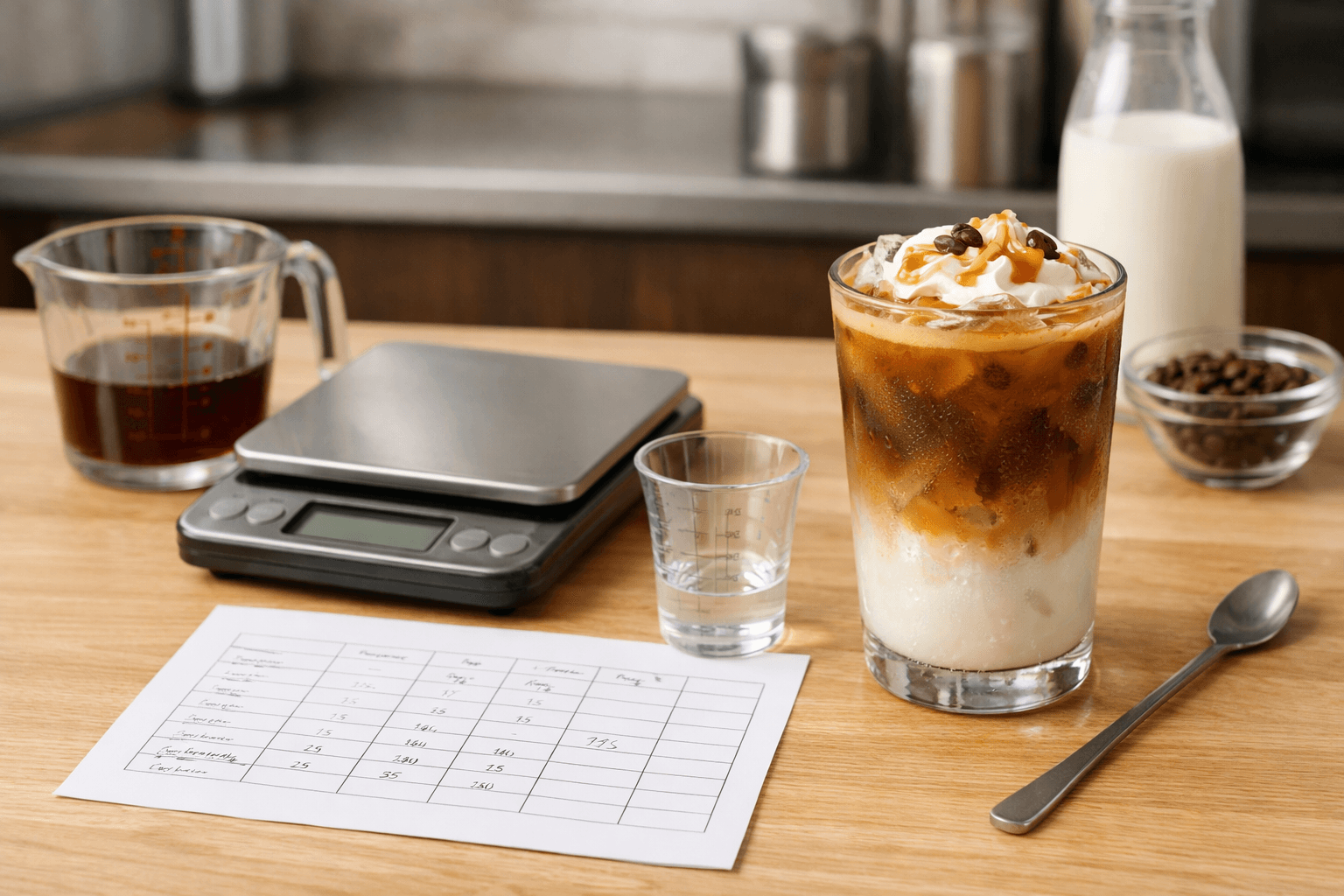
Why should cold drink recipes be standardised?
For cold drink shops in Vietnam, how to standardise cold drink recipes starts with clearly recording the ingredients, quantities and procedures. A drink can change noticeably simply because the person preparing it uses a different measuring cup, adds the ice at a different time or changes the order of the ingredients. Therefore, the recipe used at the counter should not just be a list of ingredients; it should be a short process that is clear enough for multiple employees to follow in the same way.
People who are new to opening a shop often ask whether they should start with the ratios or the mixing order. The practical answer is to record both, then describe the state of the finished product as a basis for comparing different batches. The aim of standardisation is not to create a recipe that remains unchanged in every situation, but to reduce unintended differences during preparation.
In counter operations and staff training, differences between recipe versions often arise from the ingredients, equipment or preparation habits. Before putting a drink on sale, the person in charge should finalise one internal version, clearly record the preparation method and change only one factor in each trial.
1. Identify the role of each ingredient
Make a list of ingredients by function instead of relying on memory. For cold drinks, the ingredients can be grouped into the base, the main flavouring ingredient, the sweetening or body-building ingredient, the adjusting liquid, ice and finishing elements.
| Group to record | Checking question |
|---|---|
| Base ingredient | How does it create body, richness or texture in the drink? |
| Main flavouring ingredient | Is this the flavour the drinker should identify first? |
| Adjusting ingredient | How does it change the sweetness, acidity, dilution or intensity? |
| Ice and finishing elements | Is the ice weighed, measured or added by volume? Does the finishing element affect the quantity? |
This grouping method helps identify missing information in a recipe. For example, writing “add enough ice” does not indicate the final volume, while writing “stir until combined” does not describe when to stop.
If the drink uses ice cream or a Gelato base, record the product name, weight and method of adding it to the glass separately. You can also refer to Preparation Guide and view Baby Boss Gelato Products to standardise ingredient names in internal documents.
2. Record quantities using a single system
Choose one main unit for each group and use it consistently throughout the recipe sheet. Weight is often easier to check when repeating a batch, while volume may be more convenient during counter operations; the important thing is not to use grams in one instance and “one scoop” or “a little” in another for the same recipe.
What should a recipe sheet contain?
- Drink name and applicable cup size.
- The weight or volume of each ingredient.
- The temperature or condition of the ingredients at the time of use, if this affects the procedure.
- The weight of the ice or a clear convention for measuring the ice.
- Expected finished volume and a brief description of the colour, consistency and flavour.
- Trial date, person carrying out the trial and recipe version code.
Do not record a single ratio and apply it to every cup size if the amount of ice, base or finishing element changes. Create a separate conversion table for each size, then check it again with a small batch instead of simply multiplying figures based on instinct.

For ingredients in sachets or base products, record the exact product name and specification being used. When changing to another product, even if it has the same intended use, create a new trial version to avoid confusion.
3. Fix the preparation order and stopping point
The preparation order should be written using specific verbs: weigh, measure, add, stir, blend, shake, pour or finish. Avoid instructions such as “do as usual”, because new staff do not share the same procedural memory as experienced staff.
- Prepare and check all ingredients against the recipe sheet.
- Measure each ingredient using the specified unit.
- Add the ingredients in the agreed order, clearly stating which ingredient goes in first and which follows.
- Mix, shake or blend for the stated period or until the described condition is reached.
- Add the ice or finishing element according to the drink's procedure.
- Compare the finished product with the standard description before serving.
The list above is a recording framework, not a recipe for a specific drink. The preparation time, amount of ice and equipment should be filled in after the shop has tested the drink using its actual ingredients and equipment.
If using a blender or shaker, clearly record the equipment type and any relevant operating conditions. A recipe tested with one piece of equipment may produce a different result when transferred to another, so changing the equipment should also be recorded in the version history.
4. Check each batch using a comparison table
After each trial, do not simply write “good” or “not up to standard”. Assess it using criteria that can be described, such as consistency, thickness, flavour intensity, degree of ice melting and volume after finishing.
| Criterion | How to record it | Action when it differs |
|---|---|---|
| Quantities | Which ingredient was weighed or measured differently from the recipe sheet? | Correct the measuring method or revise the sheet; do not change several factors at once. |
| Preparation order | Was any step missed or carried out in the wrong order? | Rewrite the step using a verb and place it where it is easy to see. |
| Condition | Is the drink consistent, too thin, too thick or separated? | Recheck the ratios, mixing procedure and timing of the ice addition. |
| Sensory properties | Do the main flavour, sweetness and coldness match the standard description? | Adjust only one ingredient in the next trial. |
The supplied reference source contains information about preparing medicines in healthcare facilities, not instructions for drinks. It mentions checking water, ingredients, auxiliary materials and semi-finished products before preparation; when applied to record-keeping, this is only a suggestion for checking before preparation, not a basis for conclusions about drink safety or shelf life. View the reference source.
5. An easy-to-use recipe sheet template
You can start with one page for each drink. The more concise the sheet, the easier it is for staff to use at the counter; longer explanatory notes should be placed in separate training materials.
- Drink name: record the internal name and cup size.
- Version code: record the date or change reference.
- Ingredients: record the name, weight or volume of each ingredient.
- Equipment: record the required utensils and equipment.
- Preparation order: write short steps that can be ticked off when completed.
- Finished product standard: describe the colour, consistency, flavour, fill level and finishing elements.
- Batch trial notes: record deviations, suspected causes and changes for the next trial.
A version should only be approved once another preparer can read the sheet and make the drink without having to ask for basic information. Once the recipe is stable, keep one copy for use at the counter and another with an editing history so that the cause can be traced more easily when quality changes.

If you are developing a menu with multiple cold drinks, this systematisation can be combined with Gelato Knowledge or Gelato Ice Cream Setup Consultancy, depending on the shop's operating model.
Common mistakes when standardising
Recording by feel
Words such as “enough”, “a little” or “until ready” only have meaning for someone familiar with the drink. Replace them with quantities, times, numbers of actions or descriptions of conditions that can be checked.
Changing several factors in one trial
If you change the base, the amount of ice and the preparation order at the same time, it will be difficult to know which factor caused the difference. Each trial cycle should have one main change, together with clear notes.
Forgetting to record the cup size and equipment
The same drink name may require a different preparation method when the cup size or machine is different. The recipe sheet should place these two details at the beginning to avoid incorrect application.
Failing to update the version
When the ingredients or utensils change, create a new version code instead of silently editing the old copy. This helps staff know which document they are using and helps the person in charge trace the drink testing process.
Conclusion and where to start
To standardise a cold drink recipe, start with a drink that is currently being sold, record all the ingredients using the same unit system, fix the preparation order and describe the finished product. Then test it again with another preparer, compare each criterion and change only one factor in each trial cycle.
A good recipe sheet should enable someone else to prepare the drink correctly without having to guess. When you need to expand your product range, you can view Gelato Pro Ice Cream or get in touch via the Contact page to choose an approach suited to your shop model.
References
Partner with Baby Boss
Explore our products and Baby Boss services, or call 1900998880.
Shopee · TikTok · Instagram · Threads · YouTube · LinkedIn · Zalo OA · Pinterest
Comments