
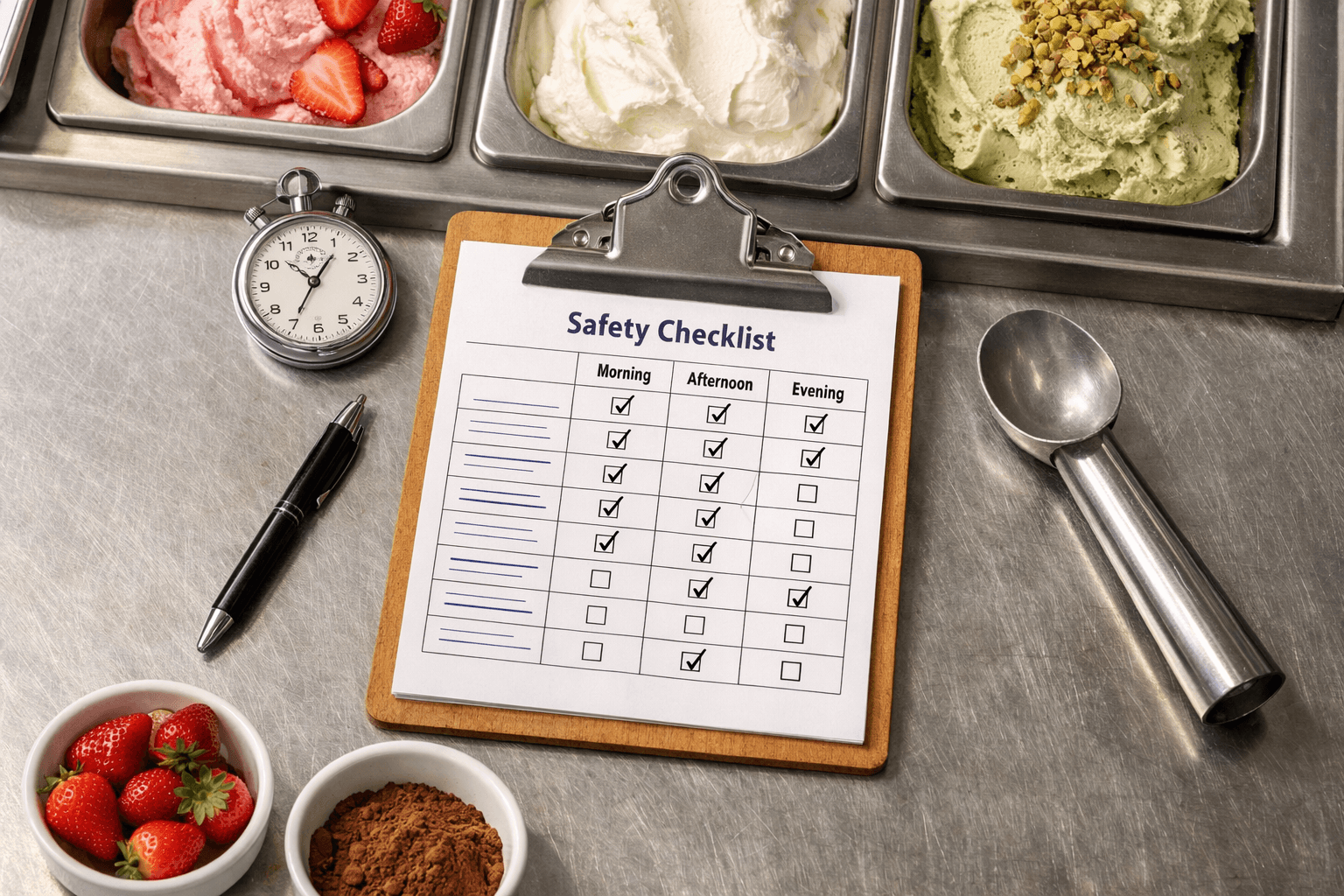
A tick-box inspection sheet can still miss the most important point: when a non-compliant result is found, what must staff do next? If the answer is simply “report it to the manager” without specifying who to report to, where to record it and which task needs to be paused, the form remains a mere formality.
To build a gelato food safety checklist that can be used during a shift, the person drafting it needs to turn principles into observable actions, assign them to a specific role and define in advance how deviations are to be recorded. WHO guidance and the FDA Food Code can support this work, but each document has a different role.
What roles do WHO and the FDA Food Code play when building a checklist?
WHO states that the Five Keys to Safer Food were developed to educate consumers and food handlers about safe food-handling behaviour. This is a concise layer of messaging, suitable for guiding how staff view their daily work.
FDA Food Code has a different purpose. The FDA publishes this document as a model providing a scientifically sound technical and legal foundation, thereby supporting regulatory authorities in the United States in developing or updating requirements for the retail and food service sectors.
| Document | Role when building a checklist | Use to avoid |
|---|---|---|
| WHO's Five Keys | Provide a foundation for behaviour and easy-to-understand messages for food handlers | Keep them as slogans without turning them into observable tasks |
| FDA Food Code | Refer to its structured approach to managing retail and food service operations | Treat it as a regulation that automatically applies to a gelato counter in Vietnam |
The two sources can complement each other: WHO messaging provides behavioural guidance, while the FDA Food Code approach suggests more specific management questions. Who checks? When is it checked? What evidence is recorded? What happens if it does not meet the standard?
One checklist line needs to answer six questions
A “done” box only confirms that someone has just ticked it. For a gelato counter checklist to generate useful information in practice, each line should contain all six of the following components:
- Subject of the check: State one specific area, condition or task; avoid broad phrases such as “ensure hygiene”.
- Action: Use observable verbs such as check, cross-check, record or set aside.
- Person responsible: State the role at the counter, such as the person opening the shift or receiving goods, instead of assigning it generally to “all staff”.
- Timing: Link the check to an operational point such as receiving incoming goods, opening the counter, handover or closing the shift.
- Evidence: Define in advance what needs to be retained, such as a compliant or non-compliant status, time, measurement, signature or note.
- Action for deviations: State the immediate action and the role authorised to decide the next step.
This structure does not create technical standards by itself. Its purpose is to require the person drafting the checklist to place the standards established by the business in the right locations, rather than leaving staff to interpret them for themselves during service.
How can principles be turned into tasks at the counter?
Preserve the meaning before shortening the wording
Do not start with the aim of writing as many lines as possible. For each message in the WHO document, first identify the behaviour it is intended to encourage; only then turn that behaviour into a check suitable for the counter's operations.
One principle may appear in several locations and at several points in time. If it requires two people to carry it out or produces two types of evidence, it should be split into two lines. Packing multiple requirements into a single “compliant or non-compliant” box makes it difficult for the manager to know which part is actually problematic.

Organise it around the rhythm of the shift
Easy-to-use forms usually follow the workflow: receiving incoming goods, preparing the counter, serving, handover and closing the shift. This is a way of organising information, not a fixed list of legal requirements.
When designing a new counter, the checklist draft can be placed beside the workflow diagram to identify tasks without an assigned person or inspection points that are not well timed. On the Baby Boss channel, the content on Gelato setup consultancy is a point of contact for businesses wishing to discuss how to arrange processes at the counter. The food safety checklist must still be checked by the business against its operating conditions and the requirements applicable at the specific location.
Separate verification criteria from operating instructions
A checklist should be short enough to use during a shift; operating instructions can be more detailed. If a task consists of several steps, the form should only state the point to be verified and direct users to the corresponding guidance document.
This separation allows the business to update operating procedures without rewriting the entire form. Supporting training materials can be organised separately in the mixing instructions, after being reviewed against the business's actual procedures and requirements.
What does a gelato food safety checklist framework include?
The sample below illustrates how to organise responsibilities, timing and evidence. The framework does not pre-set temperatures, storage times or technical limits. These values should only be entered after the business has determined the appropriate basis.
| Task group | Check question | Person responsible | Timing | Result to record | Action if non-compliant |
|---|---|---|---|---|---|
| Receiving inputs | Have all criteria approved by the establishment been fully cross-checked? | Receiving role | On receipt | Pass, fail and relevant notes | Separate and transfer to the authorised decision-maker |
| Preparing the counter | Have all checks required before serving been completed? | Person opening the shift | Before serving | Time and confirmation | Do not put the relevant area into use until the issue has been dealt with |
| During the shift | Do the conditions requiring monitoring meet the criteria established by the establishment? | Person assigned to the position | At the intervals specified by the establishment | Required observation results or measurements | Record the deviation and notify the shift supervisor |
| Handover | Have deviations and work in progress been handed over clearly? | Person handing over and person taking over the shift | When changing shifts | Content, time and confirmation by both parties | Do not end the handover while any responsibility remains unassigned |
| Closing the shift | Have end-of-shift tasks been completed and confirmed by the responsible person? | Person closing the shift | End of the shift | Completion status and notes | Create tasks to be dealt with before the next counter opening |
This is a framework for the establishment to fill in its own requirements, not a certification that the counter meets food safety regulations. Baby Boss presents the template as a starting point for those standardising operations; related topics can be found in the F&B business guidance.
How can you tell whether a checklist is too long or difficult to use?
A form that looks clear at a desk can become cumbersome during serving hours. A practical way to check is to give the draft to the actual user role for one shift, then review the lines that are often left blank, ticked out of habit or completed only after asking for further information.
- If two people interpret a line in two different ways, rewrite it as an observable action.
- If a line contains several tasks, split it into separate lines.
- If no one knows what to do when the result fails, add an immediate action and specify the level of authority for making the decision.
- If the form requires a technical value, state the approved basis determined by the establishment.
- If two checks overlap but provide no additional information, consider combining them or changing the timing.
After testing, the manager should identify the version in use and the date it takes effect. When the procedure changes, the checklist should also be reviewed; otherwise, staff may complete the old form correctly but no longer follow the new work process correctly.
Why do checklists easily turn into a formality?
Wording that cannot be verified
“Always ensure safety” sounds reasonable but does not tell staff what they need to look at, measure, cross-check or record. A good check should lead to a clear result and a corresponding response.

Copying an international document in full
WHO’s educational messages and FDA’s management model serve different purposes. Copying them verbatim may create a lengthy document that is not linked to the work position, checking time or responsibilities during the shift.
Filling in technical thresholds from memory
A familiar number is not necessarily suitable for the establishment. Limits on temperature, time or technical conditions should appear in the checklist only after being cross-checked against the applicable basis.
No deviation-handling process
A “fail” box is not the end point. The checklist needs to tell users which task must be paused, what should be separated if appropriate, which role must be notified and where the decision should be recorded.
Is the FDA Food Code an applicable regulation in Vietnam?
This document should not be presented in that way. WHO developed the Five Keys to educate people about safe food-handling behaviour; FDA publishes the Food Code as a model to support regulatory authorities in the retail and food service sectors in the United States.
Therefore, the two documents are international reference sources, not the sole basis for determining the legal obligations of a gelato counter in Vietnam. Before issuing a gelato food safety checklist, the establishment needs to cross-check its contents against the applicable legal requirements and the specific conditions at the business premises.
International sources help managers ask clearer questions. A review at the establishment is what determines which criteria the form must contain, who is responsible and which response is appropriate.
A short test before issuing it
Look at each “fail” line and ask: does the person standing at the counter know what to do immediately afterwards? If the answer is still ambiguous, the checklist is still missing the link between detection and handling.
A usable version does not necessarily need to be long. It needs to address the right task, involve the right person, be used at the right time, contain evidence and provide a clear course of action.
References
Join Baby Boss
Explore products and Baby Boss services, or call 1900998880.
Shopee · TikTok · Instagram · Threads · YouTube · LinkedIn · Zalo OA · Pinterest
Comments