
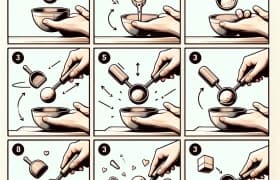
Ice Cream Scoops: A Guide to Choosing the Right Tool for F&B Outlets
In Vietnam’s restaurant and café (F&B) business, particularly in major cities such as Ho Chi Minh City and Hanoi, controlling the cost of ingredients (Food Cost) is vital. For shops selling Italian Gelato or self-serve ice cream, an ice cream scoop is not merely a tool for serving ice cream; it is also a “precision scale” that directly determines portion sizes and profit per cup of ice cream sold.
Today, in the restaurant equipment market, the two most commonly used tools are plain-handle ice cream scoops and spring-loaded ice cream scoops. Drawing on its experience in providing professional F&B solutions, Baby Boss will provide an in-depth analysis of the advantages and disadvantages of each type to help shop owners make the best choice.
1. Analysis: Plain-Handle Ice Cream Scoops
The plain-handle ice cream scoop is a traditional tool favoured by many professional bartenders and gelatiere around the world.
Construction and durability
According to common technical specifications, this type of ice cream scoop is usually cast as a single piece from high-grade aluminium alloy or stainless steel (Inox 304). Thanks to its seamless design, with no moving mechanical parts, it offers extremely high durability and will almost never break under normal conditions in shops.
Advantages and disadvantages in operation
-
Advantages (Aesthetics & cost efficiency): Thanks to heat transfer from the user’s palm to the scoop bowl (which usually contains an anti-freeze solution inside the handle), cutting into hard ice cream becomes easier. In particular, when using a plain-handle ice cream scoop, a skilled operator can roll the ice cream into a perfectly round shape. As the centre of the scoop is usually slightly hollow when the ice cream is rolled, 1kg of ice cream will generally produce more scoops than with the spring-loaded type, helping shop owners optimise profits.
-
Disadvantages (Requires skill): This is not a tool for “beginners”. Creating a well-rounded scoop of ice cream with a plain-handle ice cream scoop requires skilful wrist rotation. If staff are not yet familiar with the technique, the scoop will break apart and look unattractive.

2. Analysis: Spring-Loaded Ice Cream Scoops
Unlike the plain-handle type, the spring-loaded ice cream scoop is a “lifesaver” for newly recruited part-time staff thanks to its convenience and simple mechanism.
Construction
This tool is usually made from stainless steel. Its distinctive construction includes a spring-assist system integrated into the handle and a semicircular metal ejector bar that sweeps closely along the inside of the scoop bowl.
Advantages and disadvantages in operation
-
Advantages (Easy to use): Simply press the scoop firmly into the ice cream tub, then gently squeeze the handle. The spring mechanism activates the ejector bar, releasing the scoop from the bowl smoothly and decisively. Anyone can become proficient with it from the very first use.
-
Disadvantages (Aesthetics & portion control): As the mechanism presses the ice cream out from the inside, the finished scoop is usually very dense and heavy, with little air inside. This means that 1kg of ice cream will produce fewer scoops than when using a plain-handle scoop. In addition, the scoop created is usually slightly flattened at the base where it comes into contact with the ejector bar, rather than being perfectly round. Furthermore, the mechanical spring system may become jammed or break if it is not stored correctly, such as when the ejector track is not cleaned thoroughly.

3. Portioning: How Many Scoops Can Be Made from 1kg of Ice Cream?
Yield data is a vital figure that every food and beverage industry professional must understand.
According to real-world survey data from Baby Boss’s B2B customer network, ice cream scooping productivity depends on 3 factors: staff technique, the ice cream’s overrun and the type of ice cream scoop used.
For Plain-Handle Ice Cream Scoops
Because the interior is hollow when the ice cream is rolled, with 1kg of finished Italian Gelato from Baby Boss (with standard overrun), a skilled member of staff can produce an average of around 35 perfectly rounded scoops.

For Spring-Loaded Ice Cream Scoops
Spring-loaded ice cream scoops are divided into various “Sizes” based on the diameter of the scoop opening. As the scoops are denser, the number of scoops per 1kg decreases. Specifically, as follows (reference figures, with a margin of error of ±2 gram/scoop depending on hand pressure):
-
Small Size (Diameter 4 cm): Approximately 28 to 30 scoops / 1kg.
-
Medium Size (Diameter 5 cm): Approximately 23 to 25 scoops / 1kg. Suitable for cafés serving ice cream with waffles.
-
Large Size (Diameter 6 cm): Approximately 18 to 20 scoops / 1kg. Suitable for shops specialising in large cups of ice cream.

4. Conclusion: Which One Is Right for Your Shop?
No ice cream scoop is absolutely perfect; the decision depends on your operating model:
-
Choose a plain-handle ice cream scoop if you have a stable, properly trained team and want to maximise profit from each tub of ice cream.
-
Choose a spring-loaded ice cream scoop (size 4cm or 5cm) if your shop relies on many part-time staff working rotating shifts, and needs quick, easy operation without requiring advanced skills.
For your F&B shop to operate smoothly and achieve maximum profitability, choosing the right ice cream scoop is a small detail that delivers significant value. If you need further advice on premium ice cream ingredient supply solutions or professional menu setup, contact Baby Boss now – Vietnam’s leading Italian-standard Gelato brand.
B2B PARTNER CONTACT INFORMATION:
-
🌐 Official website: babyboss.com.vn
-
🍦 Explore the Gelato menu: gelato.vn
-
💼 Register for the distributor policy: kinhdoanhgelato.babyboss.com.vn
-
📞 Technical support hotline (24/7): 1900 99 88 8
Comments