
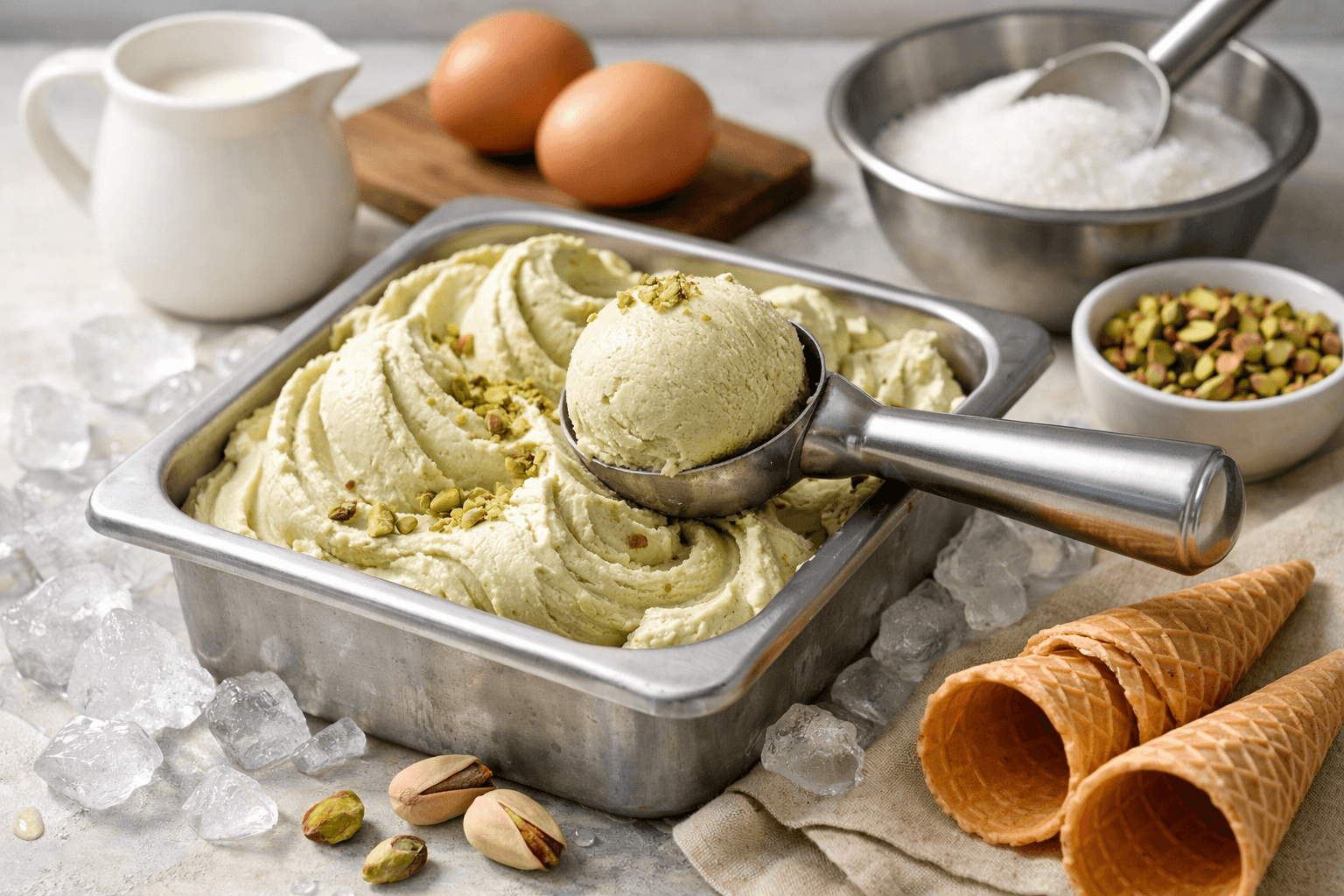
Even gelato knows when it’s cold? Gelato needs the right temperature to maintain a smooth texture, remain easy to scoop and allow its flavours to come through more clearly. Many people who are new to eating or selling gelato often think that the colder the ice cream, the better it is. In reality, temperature can directly affect firmness, scoopability and how the flavour is perceived when eating.
Gelato needs to be temperature-controlled throughout its journey: from chilling the mixture, freezing and storage through to serving. With the topic Even gelato knows when it’s cold? Gelato needs the right temperature, the important thing is to distinguish between each stage rather than looking only at one number on the freezer.
Incorrect chilling can make the product too hard, difficult to scoop or unable to express its intended texture. In gelato and F&B groups, people who have recently opened a shop often ask why the same product is much harder when taken from a freezer than when eaten in a shop. This question is usually related to the difference between gelato storage temperature and gelato serving temperature, rather than just the recipe.
Updated according to the technical documents and storage guidance available at the time of writing. The temperature points below are for reference; in actual operation, prioritise the product label and the establishment’s procedures.
Why does gelato also need the “right level of cold”?
The right temperature helps gelato balance its frozen state, scoopability and the ability to perceive its flavour. Therefore, it should not simply be assumed that the colder the product, the better its quality.
Gelato’s temperature journey from chilling to serving
Gelato does not move immediately from a liquid form to a state that is ready to scoop. The product passes through several stages, and each stage has its own temperature and cooling-rate objectives.
| Stage | Main objective | What to note |
|---|---|---|
| Base chilling | Bring the mixture to a cold state before churning | A base that is too warm or too cold can affect the result of the freezing process. |
| After churning | Create a semi-frozen state | According to accepted technical documents, the product is at around –6°C after churning. |
| Hardening | Stabilise the product for storage | The hardening stage brings the product to a storage temperature of around –18°C in the reference documents. |
| Serving | Reach a state that is easy to scoop and allows the flavour to be appreciated | Follow the guidance for each product, piece of equipment and operating procedure. |
Information about the state after churning and the hardening temperature is provided in the technical document on temperature management for frozen desserts: the product is at around –6°C after churning and is hardened to around –18°C. These are reference points for the process described and should not be understood as a single figure applicable to every recipe, machine or commercial product.
Why is gelato often difficult to scoop from a household freezer?
Household freezers are generally designed to maintain deep-frozen conditions for many types of food. For gelato, this state can make the product harder than is suitable for immediate serving, particularly when the tub is taken directly from the coldest area.

Many users on online forums share experiences of gelato becoming “hard as a rock” after being stored in a household freezer. This is a community perspective that helps reflect a common user problem but does not replace the specific storage guidance on the product label.
When gelato is too cold, it becomes more difficult to scoop and its flavour may also be less distinct. Therefore, gelato quality should not be judged solely by its firmness immediately after taking it out of the freezer. The key point to remember is that storage temperature and serving temperature serve two different purposes.
Distinguishing storage safety from serving quality
Storage temperature is intended to maintain the frozen state and support food safety control; serving temperature is intended to bring the product to a state suitable for scooping and enjoying.
The FDA recommends keeping food chilled at a suitable temperature to slow the growth of bacteria, and also advises users to check the storage guidance on the label. For freezers, this source gives 0°F, equivalent to around –18°C, as a general operating point for frozen food equipment: FDA food storage safety guidance.
However, the operating point of a freezer is not automatically the ideal serving temperature for every type of gelato. Read the label, follow the manufacturer’s guidance and consider the product type, equipment and shop procedures before setting a general temperature.
What to do when gelato is too hard
- Check the product label or guidance before changing the storage procedure.
- Place the gelato tub in a suitable serving area according to the shop’s procedures, rather than adjusting the freezer temperature down or up too much without proper consideration.
- Wait until the product reaches a more workable state before scooping; do not guess the specific time if the product does not provide corresponding guidance.
- Close the tub and return the product to storage conditions immediately after serving to limit unnecessary temperature fluctuations.
- If the product shows unusual signs in its smell, colour, surface or storage conditions, do not continue using it simply because it is still frozen.
Some community discussions mention leaving gelato out for a few minutes before eating to make it easier to scoop. This is only a user experience, not a universally applicable time, and does not replace the guidance on the label or the establishment’s food safety procedures.
Common mistakes when managing gelato temperature
Focusing only on the freezer temperature and overlooking the product temperature
The number displayed on the freezer does not always accurately reflect the temperature at the location where the tub is placed. Product arrangement, cold-air circulation and opening the freezer door can all affect the actual conditions.

Leaving gelato out for too long to make it easier to scoop
Gelato being easier to scoop does not mean it should be left at room temperature for an uncontrolled period. The FDA recommends that food requiring refrigeration should not be left at room temperature for more than two hours, or more than one hour when the ambient temperature is above 90°F, equivalent to around 32°C; see the full guidance on how long food requiring refrigeration can be kept out and prioritise the product’s procedures.
Repeatedly changing the temperature of the gelato tub
Taking the tub in and out repeatedly can make the serving process inconsistent and affect the quality of the texture. Rather than acting on instinct, the shop should establish a consistent approach to storage, when to take the product out and how to close it again after serving.
Applying one temperature to every type of gelato
Gelato can vary in recipe, ingredients, packaging and serving equipment. Therefore, the temperature points in technical documents should only be used to understand the principles, while actual operation should be based on the product’s specific guidance.
Temperature control suggestions for shops
If you are developing a gelato sales process, start by recording the temperature at important points: after freezing, when received into storage, before serving and after closing the freezer. This helps the team identify whether the product is too hard because of storage, the equipment or the waiting time before scooping.
For those looking to learn more about products and operating solutions, you can explore Gelato Baby Boss products, find out more about Gelato knowledge or learn about the Gelato setup consultancy service. This content should be combined with the specific storage guidance for each product before being applied in a shop.
Conclusion
Gelato does not just need to be cold; its temperature needs to be properly controlled at every stage. Chilling to stabilise the product, storing to maintain quality and serving it in a suitable state are three objectives that should be distinguished.
If gelato is too hard, do not immediately conclude that there is a problem with the product. Check the guidance on the label, the condition of the freezer, how the tubs are arranged and the process for taking the product out to serve before changing the temperature.
Partner with Baby Boss
Explore our products and Baby Boss services, or call 1900998880.
Shopee · TikTok · Instagram · Threads · YouTube · LinkedIn · Zalo OA · Pinterest
Comments