
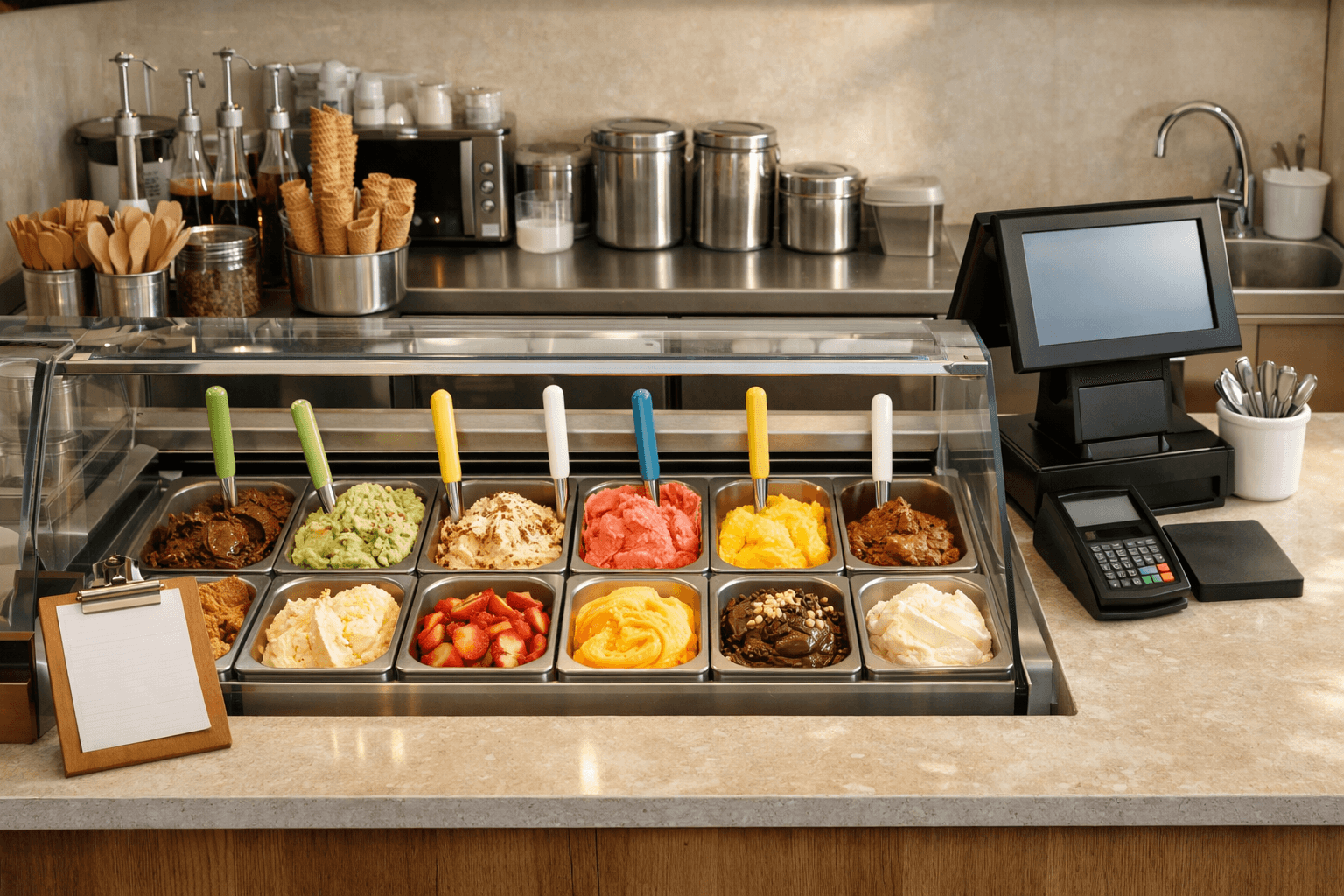
Gelato counter operations control is not just about checking how gelato is scooped. It is how the owner views the entire journey of an order: the customer places the order, the staff member takes it, the item is prepared, the transaction is completed and the figures are reconciled at the end of the shift.
Updated: March 2025. The principles in this article are intended as operational guidance. For specific requirements relating to products, equipment and food safety, owners should consult specialist guidance and the regulations in force at the time of implementation.
Why you need to view the gelato counter as an operating system
A gelato counter can encounter problems at more than just the scooping stage. The customer places the order, the staff member takes it, the item is prepared, payment is made and the end-of-shift figures are all linked. If each problem is fixed in isolation, it is difficult for the owner to know where the issue began.
The F&B store operations training materials from Concepts Academy also approach the store as a system comprising revenue, costs, customer experience and the team, while linking these to SOPs, shifts, stock and basic operational indicators (reference source on store operations). For a Gelato counter, this approach helps the owner create a short but regular checking cycle.
The aim is not to add as many forms as possible. The aim is to clarify who does what, which points an item passes through, where ingredients may be lost and what needs to be confirmed before the shift ends.
Reviewing the order flow from customer order to payment
The starting point should be the actual order flow, not an idealised diagram. Observe one complete cycle from the moment the customer places the order until the item is handed over and the transaction is completed; this is also the review approach mentioned in the F&B operations materials: the customer orders, the item is prepared and payment is made.
Mapping the journey of an order
- Taking the order: confirming the item, quantity and any special requests that the counter can fulfil.
- Passing on the information: the order is passed to the person preparing the item in a consistent way, avoiding reliance on personal experience and memory.
- Preparing the item: checking the prepared item against the order before handing it to the customer.
- Payment: checking that the transaction corresponds to the order, particularly when one staff member both sells and prepares the item.
- Completion: marking the order as complete so that it is not missed or prepared twice.
Do not assume that a small counter can skip the checking step. When one person takes on several roles, a brief confirmation at the handover point between steps helps reduce reliance on memory and habit.
Questions to use when observing
- Where do customers place their orders, and how do staff record them?
- Who is responsible for confirming the item before it is handed over?
- Is a paid order clearly distinguished from an unpaid order?
- When the counter is busy, which step is most likely to be skipped?
- If the wrong item is served, can the counter trace where the error occurred?
People opening a shop for the first time often ask whether they should start with SOPs or staff training. A more practical approach is to observe the flow currently in operation, record the sticking points and then write a short procedure that suits your own counter. You can also explore the F&B business guidance to place this review framework within a broader operations plan.

Allocating staff roles and controlling shifts
Allocating roles does not necessarily mean that each person does only one task. What needs to be clear is who is primarily responsible at each point for taking orders, preparing items, handling payment and checking at the end of the shift.
Three points to clarify in each shift
- Person in charge: who makes the decision when there is a problem with an order or a customer needs assistance?
- Handover point: how is information passed from one person to another?
- Checking point: who checks the items, transactions and figures before the shift ends?
When a shift is staffed by only a few people, one staff member may take on several tasks. In that case, the owner needs to set out priorities and points at which to stop and check, rather than expecting staff to balance everything themselves during busy periods.
At the end of the shift, record recurring errors instead of giving only general reminders. An order error, an incorrectly portioned scoop or an unexplained amount of ingredients are all data that can be used to adjust role allocation, guidance or the counter layout.
Identifying wastage at the Gelato counter
Wastage does not always appear as a large entry in the accounts. F&B operations materials cite examples such as sauce sticking to the bottom of a bottle, excess ice and incorrect portioning; these small details should be included in the daily observation list (see the source on types of invisible loss).
Categorising wastage points by timing
| Timing | Point to observe | Checking question |
|---|---|---|
| Shift preparation | Ingredients, equipment and portion sizes | Have they been prepared in a consistent way? |
| During the shift | Scooping gelato, using sauce, using ice and serving items | Are there any actions that leave ingredients in excess or cause them to be left behind? |
| Handover | Orders, items delivered and the remainder | Does the actual quantity match the quantity recorded as sold? |
| End of shift | Stock and unexplained discrepancies | At which stage did the discrepancy arise? |
This table does not generate standard figures automatically. If the counter does not yet have sufficiently reliable data, it is best to start by recording the current situation across similar shifts before considering adjustments. Do not set storage periods, standard portion sizes or wastage rates without an appropriate basis related to the products and the counter’s processes.
For better control, separate the two questions: “how many were sold?” and “how much was used?”. The gap between the two figures should be explained by recorded causes, rather than automatically being treated as an employee error.
Include food hygiene in the inspection framework
Food hygiene should not be a separate inspection item that only appears when an incident occurs. The World Health Organization developed the “Five Keys to Safer Food” to guide safe food-handling practices for consumers and food handlers (WHO guidance on safe food handling).

At system level, the Codex Committee on Food Hygiene states that the core text is the General Principles of Food Hygiene CXC 1-1969, which includes guidance related to the Hazard Analysis and Critical Control Point (HACCP) system (Codex guidance on food hygiene).
How to incorporate hygiene into daily operations
- Identify the steps that involve direct contact with the product and include them in the shift checklist.
- Clearly state who is responsible for the inspection, when it should take place and how to handle any failed point.
- Do not use a general form as a substitute for professional guidance, local regulations or product-specific requirements.
- When equipment, ingredients or serving methods change, review the points where hazards could arise.
The framework above is intended only as operational guidance; it is not a food safety certification procedure or legal advice. For specific requirements concerning products, equipment and premises, the owner should check current regulations and appropriate professional guidance.
End-of-shift operational review framework
A short review is more useful when it focuses only on observable data and events. The following sequence can be used to close the shift:
- Reconcile the number of orders received, items delivered and completed transactions.
- Record errors arising in the order flow, at the handover point and at the time they occurred.
- Check identified wastage points; do not speculate about the cause without data.
- Record any hygiene issues requiring action or confirmation by the person responsible.
- Choose one priority issue to address during the next shift.
The counter can expand this framework into an SOP once the actual workflow is clearly understood. If you are choosing products and planning how to organise the counter, you can explore Baby Boss Gelato products or discuss Gelato ice cream counter setup consultancy to connect product considerations with operations.
Conclusion
Controlling the operations of a Gelato ice cream counter begins with seeing the complete journey of an order, then linking that journey to role allocation, wastage and food hygiene. When every handover point has a clearly responsible person and a clear method of confirmation, the owner has a better basis for correcting errors rather than simply dealing with situations as they arise.
Start with an actual shift: observe, record, reconcile and choose one point for improvement. Matters for which the counter has no specific data—such as portion sizes, wastage rates or storage periods—should remain undefined until there is an appropriate basis.
References
Partner with Baby Boss
Explore products and Baby Boss services, or call 1900998880.
Shopee · TikTok · Instagram · Threads · YouTube · LinkedIn · Zalo OA · Pinterest
Comments