
The operational guidance sources are referenced in the March 2025 update. When applying them, the counter team should also cross-check the product information and current regulations.
A delicious test drink can still fail when sold in real service
The person developing the drink has just made a milk tea with gelato exactly as intended. They remember the amount of tea, know how much gelato to take and adjust it immediately when the flavour seems unbalanced. But during a busy shift, another member of staff picks up the recipe and still has to ask: which equipment should be used, which ingredient goes in first, and where are the customer's specific requests recorded?
The gap between these two situations is precisely what the counter team needs to standardise. The issue is not only the tea or gelato flavour, but also the quantities, order of operations, transfer of information and checks before the drink is handed over.
The testing stage therefore does not require a large number of versions. More importantly, each test should answer one clear question and leave enough data for someone else to recreate the drink. If several ingredients are changed at the same time, it will be difficult for the counter team to know which change actually produced the result.
Prepare a compact testing round for comparison
There is no single ratio that suits every tea base, gelato flavour and counter setup. The recipe should be established using the same ingredients, equipment and workflow intended for use during sales.
If the counter team is choosing a gelato range for drink development, it can consider the Baby Boss Gelato product, then test each option with the actual tea base. Do not assume that different gelato flavours will suit the same quantities.
Finalise the ingredients before starting
- The tea base and the way each batch of tea is identified.
- Ingredients that create the milky or sweet flavour, if used in the recipe.
- The specific gelato flavour for the testing round.
- Ice and the accompanying ingredients actually included in the drink sold at the counter.
Every ingredient present in the test drink must appear on the record sheet. If a detail is added out of habit but not recorded, the selected version can easily change when it is handed over to another person to prepare.
Use measuring tools instead of estimating by eye
- Measuring tools suitable for each ingredient.
- A clock or timer if the tea process includes a step requiring time to be monitored.
- Test glasses of the same type or clearly marked.
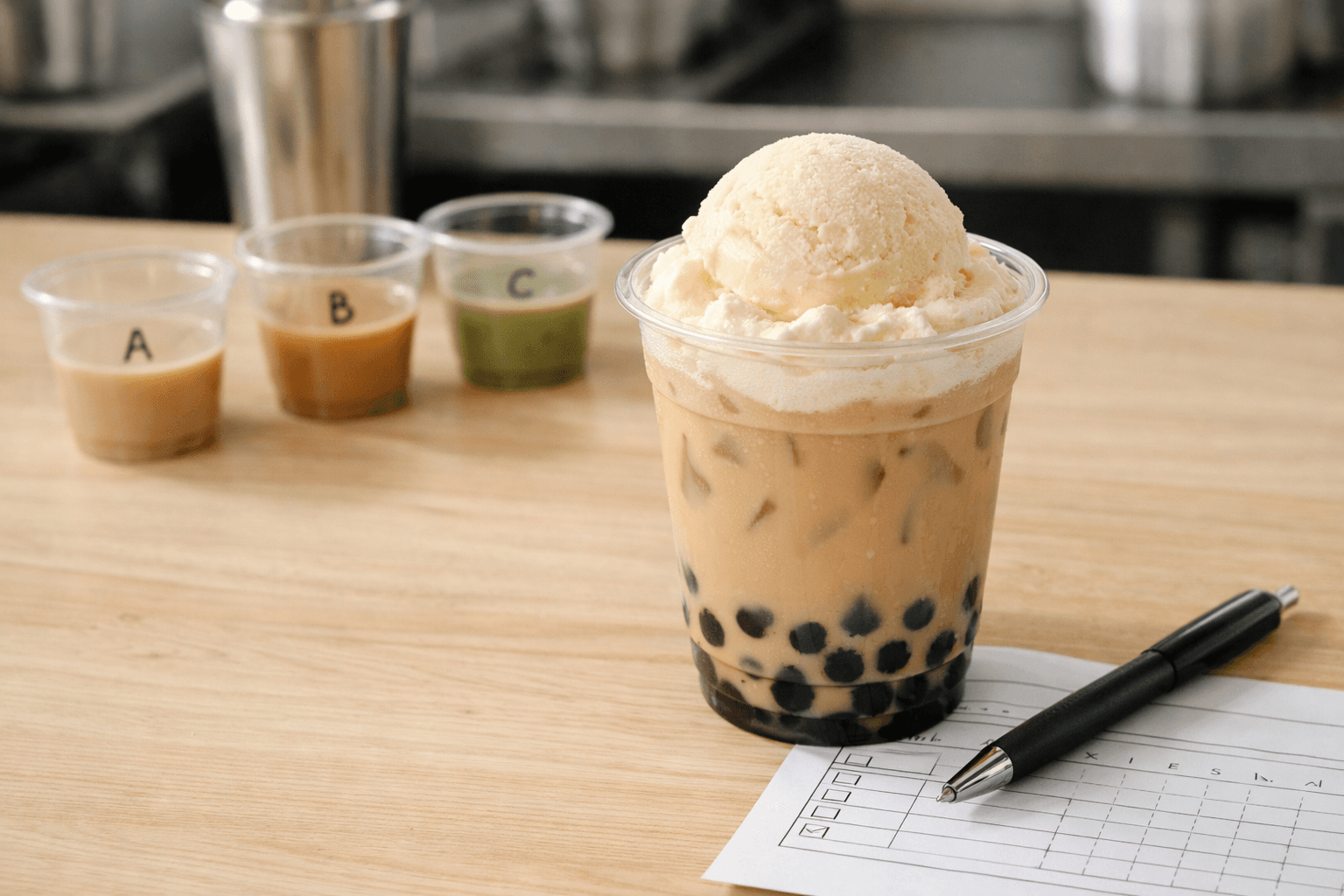
- Sample record sheets, a pen and identification labels for each version.
- Separate equipment for scooping gelato, cleaned in accordance with the establishment's procedures.
This list may vary depending on the setup. The principle to maintain is that every sample must be measured and identified in the same way, rather than relying on the preparer's memory.
Test flavours by variable, not by instinct
To understand how the gelato affects the drink, keep the tea base, remaining ingredients, glass type and order of preparation unchanged. When assessing the tea base, reuse the selected gelato version. Changing only one variable in each round makes it easier to identify the cause when comparing results.
- Ask: Does this round need to review the tea base, the amount of gelato, the sweetness or the order of preparation?
- Set up a control sample: record the full version currently in use before making adjustments.
- Change one factor: assign a separate code to each sample to avoid mixing up the glasses.
- Describe the result: clearly record which ingredient dominates, which one is not yet noticeable, or how the drink's condition changes at the time of checking.
- Choose a sample to recreate: follow the record sheet exactly instead of relying on memory.
Comments such as “delicious”, “fine” or “not quite there” are too vague to lead to a specific adjustment. The testing sheet needs to show which aspect is being assessed and which sample is being used as the comparison benchmark.
A simplified flavour testing sheet
| Field to record | Content |
|---|---|
| Sample code | A unique identifier for each version |
| Tea base | Tea type, batch code and the information being monitored by the counter team |
| Gelato | Flavour used and the actual amount taken |
| Other ingredients | The name and actual amount of each ingredient |
| Order of operations | The steps in the exact order carried out |
| Comments | Description of the tea base, creaminess, sweetness and condition of the drink |
| Result | Keep unchanged, adjust further or reject the sample |
The counter team can place this sheet beside the documents in the mixing guide. Only fields that genuinely support decision-making should be retained; a long form that is regularly left blank will not help trace the cause.

Do not approve the sample before someone else can recreate it
The selected version should be recreated exactly according to the sheet, preferably by someone who was not directly involved in developing the drink. This is a way to check whether the instructions are clear enough or still depend on the writer’s tacit knowledge.
If the person making it has to keep asking questions, record exactly where they get stuck: missing quantities, unclear equipment, mixed-up order or no recognisable signs that the drink is complete. These questions are data for improving the process, not the reader’s fault.
The gelato milk tea sample should only move to the standardisation stage when someone else can read the instructions, carry them out and compare the result without having to guess at important details.
Turn the trial log into a process that can be used at the counter
A product development log can be long, but the document for a selling shift needs to be short and clear. The process should include ingredients, quantities approved by the counter, equipment, operating sequence, completion indicators and the person responsible for checking.
According to Baby Boss’s gelato counter operations control framework the goal is not to create a large number of additional forms. The counter needs to clarify who is responsible for what, which checkpoints the drink passes through, where ingredients may be lost and what must be confirmed before the shift ends.
Six process questions that need answering
- Which exact ingredients does the drink use?
- Which equipment is used to measure each ingredient, and in what quantity?
- In what order do staff carry out the steps?
- How are customers’ specific requests recorded and passed on?
- Who checks the drink against the order sheet before handing it over?
- If the drink does not meet the standard, where does the staff member record the error and whom do they report it to?
The gelato milk tea preparation process must follow the real workflow. When one person is taking orders, preparing drinks and handling payment at the same time, the document needs to define checkpoints for verification even more clearly. Staff should not be expected to remember every detail during busy periods.
Place verification checkpoints along the order journey
Even a clear recipe can be carried out incorrectly if information is interrupted. Baby Boss’s operations framework views the counter as a linked chain from the moment the customer places an order, through order taking and preparation, to the completion of the transaction and the reconciliation of figures at the end of the shift.
| Operational checkpoint | Content to be verified |
|---|---|
| Order taking | The drink name, quantity and requests that the counter can fulfil |
| Information transfer | The order sheet is passed on in a consistent way, rather than being communicated only verbally |
| Preparation | The approved recipe version, equipment and sequence are used correctly |
| Hand-over | The completed drink is checked against the information received before it is handed over |
| Completion | The transaction and completion status are clearly identified |
At the end of the shift, errors should be recorded according to where they occurred: the wrong drink taken, incomplete information passed on, the wrong quantity measured or a verification step missed. This is more useful than a general comment such as “the mixing was inconsistent”, because the manager knows which part needs correcting. The counter can place the form within the broader framework of the group’s F&B business guidance.
Errors that undermine standardisation
Changing too many factors in the same round
Changing the tea, gelato quantity and sweetness level at the same time means the counter cannot isolate the cause. It is better to divide the process into smaller rounds, keep a control sample and use clear codes.
Recording results as general impressions
A single word such as “fine” does not tell the next person what needs to be retained. Describe the ingredient that is overpowering, what needs adjusting and which sample was used for comparison.

Writing from the product developer’s memory
Documents that lack measuring equipment, sequence or completion indicators force new staff to interpret them for themselves. Have someone else carry out the process and record every point where they need to ask a question.
Only correcting the drink while overlooking the information flow
The wrong drink does not necessarily originate at the preparation station. Information may become inaccurate at the point of order taking or hand-over, so the review should work backwards from the drink handed over through each verification checkpoint.
Food safety must be part of the main process
The World Health Organization developed “Five Keys to Safer Food” to educate consumers and people who directly handle food about safe food-handling practices.
For drinks containing tea, dairy ingredients and gelato, hygiene, storage and ingredient-handling requirements need to appear directly in the process used at the counter. The business must also cross-check professional guidance and current regulations applicable at the place of business.
Do not infer storage temperatures or shelf life without appropriate confirmation from product information, professional guidance and applicable regulations. During the trial round, use only ingredients approved by the counter and equipment that has been handled according to the business’s food safety procedure.
What can Baby Boss support?
This content was published on a channel belonging to Baby Boss. For a counter developing gelato milk tea, Baby Boss can provide information about gelato options and discuss how to incorporate the products into the counter model. The final recipe still needs to be tested using the exact tea base, equipment and operating flow of each business.
If you need to review product choices, the location of the preparation station or how to organise the workflow, the counter owner can submit their requirements via the Gelato ice cream setup consultancy. Before the discussion, prepare the tasting sheet, the process currently in use and the list of recorded issues. A clearly described problem is easier to address than a general request such as “it needs to be mixed more consistently”.
A brief standard, but it must be reproducible
The starting point is not a lengthy document. The counter needs a reproducible sample, a sheet containing all the necessary data and checkpoints placed at the right points in the ordering journey.
When the results change, go back to the sample code, quantities and operating steps instead of adjusting things from memory. Standardisation does not lock in product development; it helps the counter know what it is changing and why.
References
- World Health Organization: Five Keys to Safer Food
- Baby Boss: Gelato counter operations control framework
Partner with Baby Boss
Explore products and Baby Boss services, or call 1900998880.
Shopee · TikTok · Instagram · Threads · YouTube · LinkedIn · Zalo OA · Pinterest
Comments