
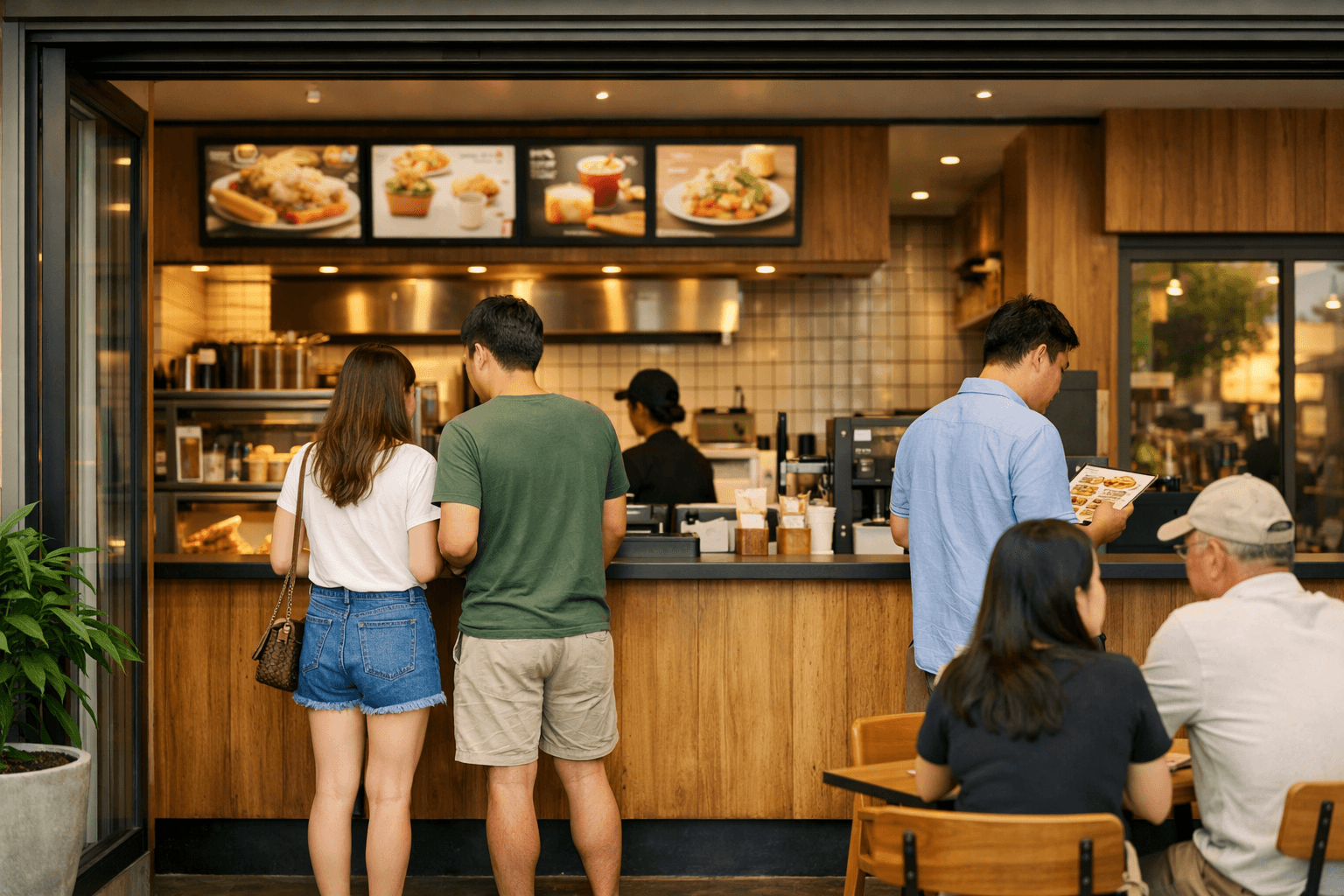
Diners’ spending habits are changing
F&B customer retention strategies for 2026 do not begin solely with attracting new customers. Owners must also answer a more difficult question: what makes customers return when dining budgets are being considered more carefully?
People still want to eat out, but are becoming more selective about the occasions, prices and places they are willing to return to. According to the summary of the 2025 Vietnam Culinary Business Market Report published by Horeca School , the proportion of people expected to reduce their spending on dining out in 2026 is forecast to rise to 34.5%, compared with 31.1% the previous year. The proportion of those expecting to maintain their spending also fell from 54.2% to 50.5%.
Many people in F&B groups often ask about falling sales, ways to bring customers back and the ability to operate as costs rise. These concerns show that retaining customers is becoming a more practical challenge than expanding too quickly.
Businesses therefore need to focus on the value customers perceive each time they visit, rather than simply tracking the number of outlets.
Why is expanding the number of outlets no longer the only answer?
Opening more outlets was once a common way to increase reach and revenue. However, figures published for 2025 show that the pace of network expansion has slowed, while the industry continues to face pressure from raw materials, premises, staffing and compliance requirements.
CafeF cited a 2025 market report stating that the market reached approximately VND 726,500 billion, up 5.5% from 2024; the number of outlets increased by approximately 2%. The source noted that the growth driver is shifting from expanding the number of outlets to improving performance at each outlet.
This does not mean expansion is wrong. The issue lies in the order of priorities: a model that has not created a consistent experience and does not control costs effectively will find it difficult to maintain performance when replicated.

Three questions to ask before opening more outlets
- Does the current outlet generate sufficiently stable revenue, or is growth driven only by short-term promotions?
- Are food quality, service speed and the customer experience consistent across shifts?
- Can the model control raw materials, staffing and operating costs as it grows?
These are strategic management questions, not assessment thresholds specified in the accepted sources. For owners considering investment, answering each question clearly helps ensure that expansion decisions are more closely aligned with actual capabilities.
Real value becomes the foundation of customer retention
Real value does not mean the lowest price. In F&B, value may lie in an appropriate portion size, consistent quality, food that meets expectations, a pleasant setting or a service process that makes customers feel their spending is justified.
The report Báo Điện tử Chính phủ cited found that consumers prioritise good-quality choices at affordable prices. The same source recorded that 52.3% of Vietnamese people prioritised spending under VND 35,000 per beverage in 2024, while the frequency of consuming beverages outside the home among regular consumers increased compared with 2023.
These figures suggest an important point: customers may still spend on F&B, but they want to feel that their choice is worth the money. Therefore, continuous discounting may not necessarily create loyalty; a consistent experience and a clear brand promise provide a more sustainable foundation.
Where should value be demonstrated?
| Touchpoint | Questions businesses should check |
|---|---|
| Product | Does the signature item maintain consistent quality and flavour across selling shifts? |
| Price | Do customers understand what they receive at each price point? |
| Service | Are waiting times and the handling of feedback consistent? |
| Environment | Is the setting suitable for the primary needs of the target customers? |
| Brand identity | Does the brand message match the actual in-store experience? |
For beverage, ice cream and gelato models, it is also worth considering a focused-enough range. Owners can refer to F&B business guides and Gelato knowledge to ask questions about signature products, service processes and operational capability.
F&B operating priorities for 2026
When profit margins are under pressure, customer retention cannot be separated from operations. An appealing customer-care programme accompanied by long waiting times, inconsistent quality or frequent stockouts will struggle to create a reason to return.
The priorities below are suggestions drawn from trends in operational efficiency, cost control and value positioning mentioned by the sources. They are not a commitment that one approach will suit every model.

- Choose a small number of differentiators and make them clear: Identify the product, experience or convenience that makes customers remember the brand, rather than spreading the message across too many themes.
- Control consistency: Monitor product quality, portioning, service times and feedback during each selling shift.
- Design clear pricing: Clearly explain the differences between the options so customers can recognise the value, rather than looking only at the final figure.
- Review the range: Consider slow-moving or complex items, or those that generate significant waste; streamlining should be based on each store’s internal data.
- Measure customer return rates: Do not just track new customers, revenue and order numbers; observe return frequency, feedback and why customers do not continue using the service.
These metrics do not replace financial reports or detailed operational data. They help shop owners view growth in greater depth: the store is not merely making a one-off sale, but also giving customers enough reasons to consider returning.
What should businesses monitor in 2026?
Available data shows that demand in the F&B sector remains, but growth rates and spending sentiment are becoming more differentiated. The report Horeca School summarised recorded that 65,58% of businesses maintained stable revenue or grew in 2025, while also forecasting clearer pressure to tighten spending in 2026.
Businesses should view industry figures as signals that prompt questions, not as formulas to apply unchanged. One brand may need to prioritise price, while another needs to improve service speed; a gelato shop may instead need to focus on its product range, seasonality and the in-store experience.
Monthly review checklist
- Are customers returning because of the product, price, location or a specific convenience?
- At which point in the purchasing journey do customers have to wait or find it easy to change their choice?
- Is revenue growth accompanied by improved performance at each point of sale?
- Are promotions creating returning customers or merely short-term transactions?
- Do shop staff have enough information to communicate the product’s value accurately?
For brands developing an ice cream or gelato business model, you can also explore Gelato ice cream set-up consultancy service for reference on an approach suited to your point-of-sale plan. All investment decisions still need to be assessed against the premises, resources and actual business data.
Conclusion: Customer retention starts with consistently delivering on your promise
The 2026 F&B race may not be won by the brand with the most points of sale. The advantage will favour businesses that understand what customers are considering, control their costs and consistently deliver on their promise regarding products, value and experience.
Customer retention is not a standalone campaign, but the result of many operational details being done correctly with every service interaction. When genuine value becomes the focus, opening new points of sale has a sounder basis for generating growth rather than merely increasing scale.
In partnership with Baby Boss
Explore products and Baby Boss services, or call 1900998880.
Shopee · TikTok · Instagram · Threads · YouTube · LinkedIn · Zalo OA · Pinterest
Comments