
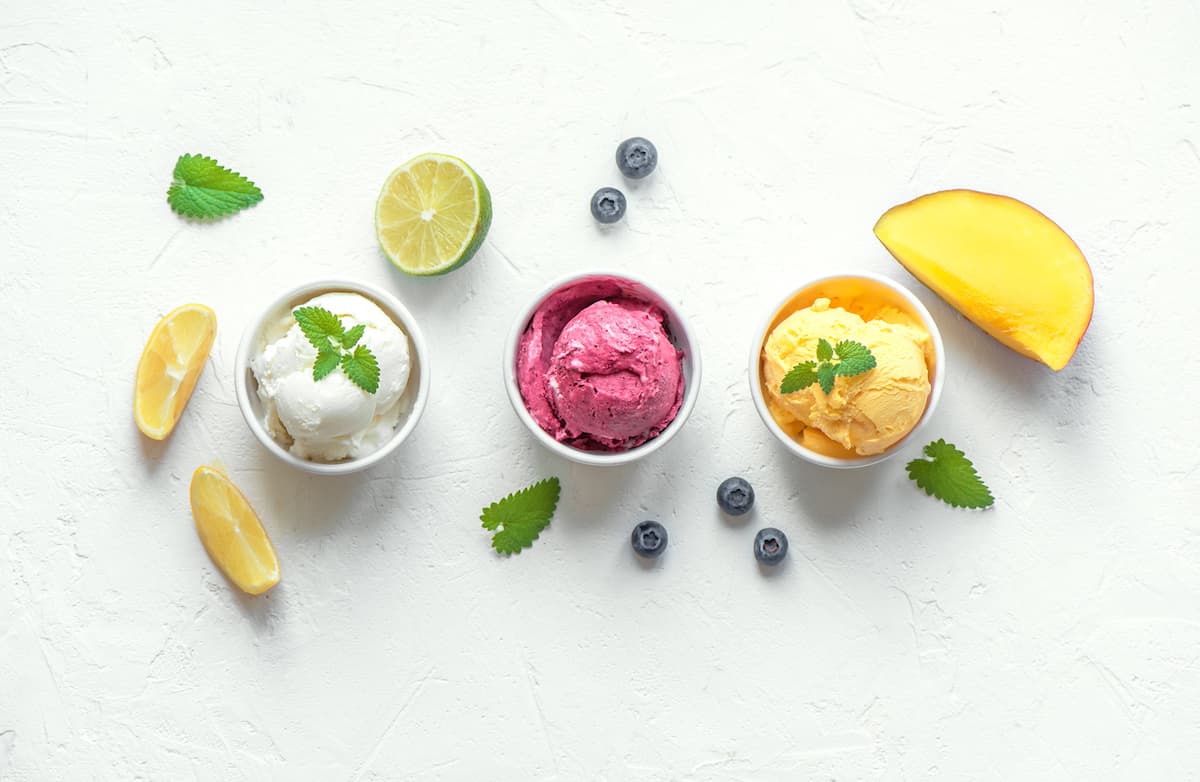
Ice cream is not only a fragrant, sweet snack enjoyed by many children, but has also become a popular dessert on our daily menus. There are many different types of ice cream on the market, and each type has its own origin, characteristics and storage methods. In this article, join us as we take a closer look at the differences between Gelato, Ice cream and Sorbet.

The origin and characteristics of Gelato
In recent years, Italian Gelato has become increasingly popular, particularly among young people. With its rich flavour and smooth texture, this type of ice cream has won over many people. But have you ever wondered about the origin and characteristics of Gelato? Let Baby Boss explain them below.
1. The origin of Gelato
During the Roman dynasty, the ice cream industry developed strongly. However, after the fall of the Empire, Italian ice cream went through a prolonged period of stagnation lasting more than 1000 years. It was not until Marco Polo discovered the Chinese recipe for making ice cream with milk instead of fruit juice, thereby creating Gelato, that the industry was revitalised.
For this reason, Marco Polo is considered the creator of Gelato. The global popularity of Gelato was marked by the marriage of King Henry II (France) and Catherine de 'Medici. In particular, in 1686, the first ice cream machine was completed by the Sicilian Francesco Procopio dei Coltelli. Thanks to this advancement, Gelato became even more widely popular among the community.
Today, Gelato production is more convenient thanks to standardised, closed-loop processes and high-capacity ice cream machines. They not only help shorten production time but also ensure consistent quality.
2. Characteristics of Gelato
Gelato is a famous type of ice cream originating in Italy, with the following distinctive characteristics:
- It is made primarily from completely natural fruit ingredients combined with sugar, water and fresh milk, and contains no preservatives or chemicals.
- One of the outstanding advantages of Gelato is its smooth, delicious texture and rich, creamy flavour, while being low in fat.
- It is produced by heating the ice cream mixture to a temperature of 85 degrees C. It is then pasteurised by holding it at a chilled temperature of -4 degrees C.
- To transform the ice cream mixture into Gelato, you need to whip it in a circular motion during the cooling process.
- The freezing temperature for Gelato is usually between -30 degrees C and -40 degrees C.
- When displayed in a specialist ice cream cabinet, the temperature should be adjusted from -12 degrees C to -14 degrees C.
Traditional Gelato flavours include vanilla, chocolate, pistachio, custard, stracciatella and hazelnut. However, if you would like to add more varied flavours, you can include other ingredients such as puréed nuts or fresh fruit.

The origin and characteristics of Ice cream
You are certainly very familiar with Ice cream, as probably everyone has enjoyed ice cream at least once. However, to gain a clearer understanding of the differences between Ice Cream, Gelato and Sorbet, join us as we explore the origin and characteristics of this familiar dessert.
1. The origin of Ice cream
Some documents state that ice cream appeared in ancient China in the 3rd century BC. However, there is also a legend that the first ice cream was created by combining wine, honey and snow from the Apennine Mountains. Royal chefs created this dessert to serve Emperor Nero during the ancient Roman period.
Later, Marco Polo, an Arab merchant, is believed to have introduced ice cream widely in Europe after obtaining the ice cream recipe in China. Meanwhile, in the 16th century, Persian emperors created Persian ice cream, also known as bastani sonnati. In South Asia, meanwhile, ice cream was made by collecting frozen water from the desert at night.
In North America, ice cream became popular from 1744, with strawberries and milk as its main ingredients. Besides strawberries, chocolate and vanilla also became popular ice cream flavours in the United States. Later, Agnes Marshall, known in England as the "queen of ices", applied liquid nitrogen in ice cream production. She wrote her own cookbook and introduced Ice cream dishes, making this food an essential part of the cuisine.
2. Characteristics of Ice cream
Ice cream usually contains milk cream and cow's milk as its main ingredients. Today, to create a variety of flavours, this type of ice cream is often combined with various additives. Besides cow's milk, other ingredients such as goat's milk, soya milk, almond milk and cashews,... may also be used to make ice cream.
In the world of Ice cream, there are two popular types: Soft-serve ice cream and Hard-serve ice cream.
- Hard-serve ice cream contains from 10% to 18% fat, is mixed thoroughly, frozen and properly stored at a temperature of -15 degrees C.
- Soft-serve ice cream contains less fat, only around 3% to 6, but has a higher air content of 33% to 45% by volume. This is a fresh cream with a lighter and smoother texture. The suitable temperature for churning and freezing soft-serve ice cream is -4 degrees C, while the best temperature for displaying and storing the ice cream is -3 degrees C.

Origin and characteristics of Sorbet
Sorbet is less popular than Gelato and Ice cream, but recently it has become appealing to young people. Sorbet's appeal lies in its sweet and refreshing flavour, making it easy to delight diners.
1. The origin of Sorbet
Around 54 AD, the Roman Emperor Nero introduced sorbet at a feast, marking the birth of a range of appealing frozen desserts around the world. Its first flavour was a combination of honey, fruit, wine and fresh snow from the summit of the Apennines.
In Asia, China is the birthplace of sorbet. At royal banquets, sorbet made from ice combined with fruit and honey was often served to the emperor. Simply put, Sorbet is a sweet and fragrant frozen dessert made from fresh fruit with added sugar.
2. Characteristics of Sorbet
There are many differences between Gelato, Ice cream and Sorbet. However, Sorbet has distinct characteristics compared with the two types of ice cream mentioned above, and you can learn more through the following features:
- Sorbet does not contain cream like Ice cream; instead, it is a simple frozen dessert with a perfect blend of flavours such as honey, wine and frozen fruit.
- To make Sorbet, you simply need to freeze fruit and blend it with sugar and water. You can then enjoy a special dessert similar to shaved ice. If you wish, you can also add yoghurt or milk to it.

A detailed comparison of Gelato, Ice cream and Sorbet
Based on the information above, we are sure you now have an overview of the differences between Gelato, Ice Cream and Sorbet, don't you? However, to distinguish between these three desserts, you only need to focus on the following points:
|
|
Gelato |
Ice-cream |
Sorbet |
|
Main ingredients |
Made from 3.25% milk, with only 30% air, and low in fat and sugar. It also contains fruit, finely ground nuts or other spices to create a wide range of flavours. |
Dairy cream or milk, combined with around 10% milk fat and some flavourings. |
Sugar, wine, frozen fruit, honey and, in particular, no cream. |
|
Production method |
Air entering the ice cream is restricted through a process of pasteurisation, cold ageing and gentle circular churning. |
The ice cream is churned at temperatures from -15 degrees C to -4 degrees C. It is made smooth and given volume by continuous churning, allowing air into it during the freezing process. |
Blend the frozen fruit finely with water and sugar until evenly broken down. |
|
Texture |
Less airy and highly elastic, smooth |
Airy, light and fluffy, but less elastic |
Not elastic but airy |
|
Suitable storage temperature |
-12 to -14 degrees C in the display freezer |
-3 degrees C to -15 degrees C |
Normal refrigerator temperature |
We hope that the information from Baby Boss will help you better understand the basic differences between Gelato, Sorbet and Ice Cream. In general, they are all ideal desserts for cooling down during hot summer weather. If you are considering starting an ice cream business and need comprehensive advice on all aspects of the ice cream industry, please contact Baby Boss's Italian Gelato self-select franchise brand now.
Comments