
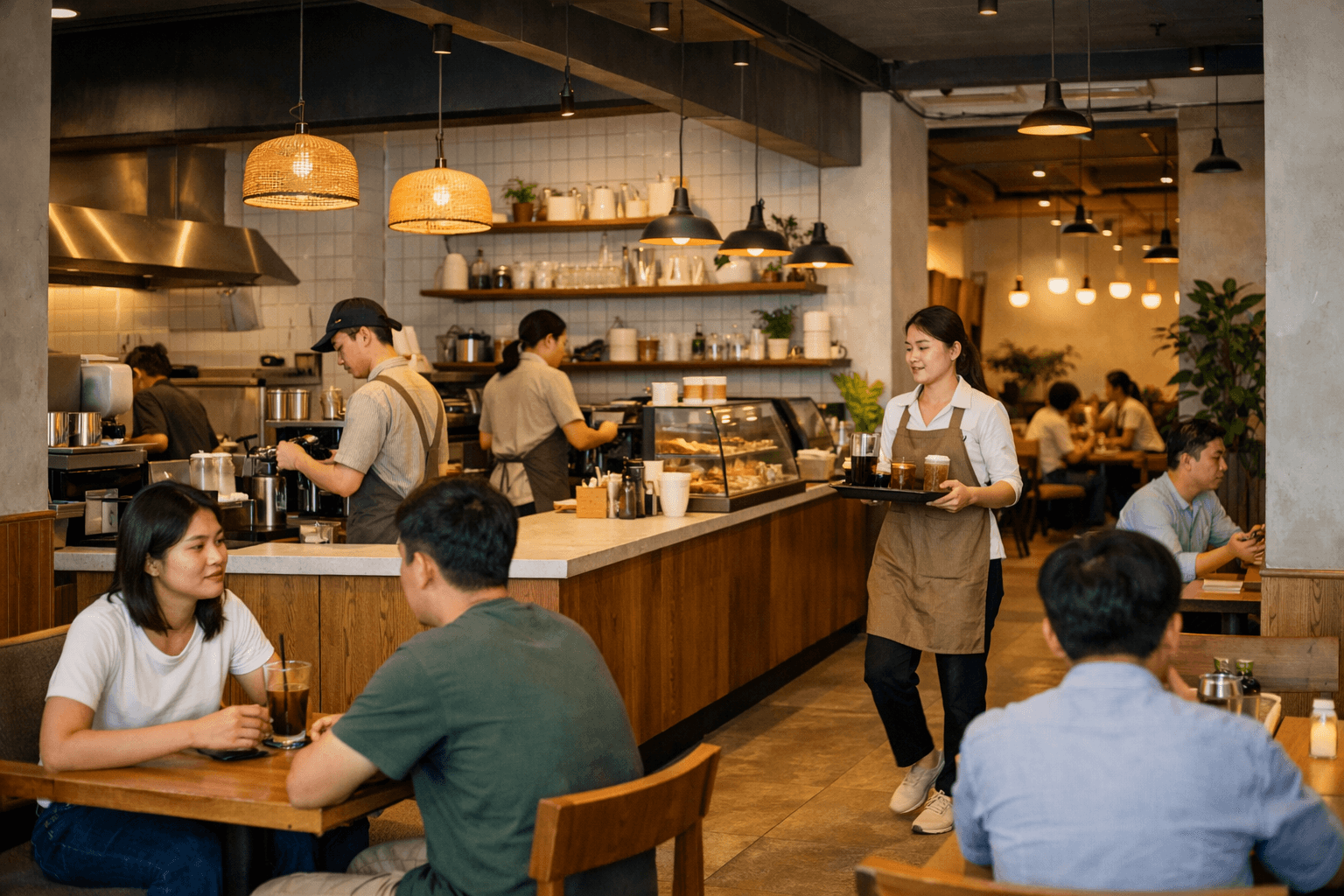
Vietnam’s F&B Market Landscape in 2026
Vietnam’s F&B market in 2026 is entering a phase different from the period of rapid expansion. According to the cited reports, the industry is shifting towards more stable growth, while businesses must demonstrate operational capability and genuine value instead of relying solely on the speed of opening new outlets.
The cited report forecasts that in 2026 the industry as a whole could reach approximately 333,600 outlets, with expected revenue of around VND 760 trillion and a growth rate of approximately 4.6%. These are forecast figures, not confirmed full-year results; businesses should therefore interpret them as an indicator of the market’s direction.
Slower growth, but demand for dining remains
Data for 2025 shows that the industry’s scale continued to grow, but the pace of expansion declined. According to the cited market report, the number of outlets reached approximately 329,500, up 2% compared with 2024; total industry revenue exceeded VND 726.5 trillion, up 5.5%.
These two figures highlight an important point: the number of outlets is not increasing as quickly as before, but spending on dining continues to generate significant revenue. In other words, competition in Vietnam’s F&B industry in 2026 is not only about who can open more outlets, but also about who can operate more efficiently and give customers a reason to return.
Conversely, the report notes that consumer spending sentiment for dining in 2026 is expected to become more cautious. The proportion of people expected to reduce their spending is forecast to rise to 34.5%, while the group maintaining its spending level is expected to fall to 50.5%; these are indicators from the report and should not be interpreted as a definite forecast for every customer segment.
Operations and cost control become key priorities
When purchasing power becomes more fragmented and input costs create pressure, an F&B model can hardly depend entirely on naturally growing revenue. The report states that 45.3% of surveyed businesses increased product prices in the first half of 2025 due to pressure from raw materials, staffing and policy impacts.
This makes questions about portion control, service procedures, staff productivity and waste control more practical. People who are new to opening a venue often ask where to start, how to learn about operations and how to retain staff; many discussions in restaurant-owner communities also focus on these issues. This is a perspective for reference from the community, not survey data or a conclusion representative of the entire industry.

From opening venues as a trend to building disciplined models
According to the report cited by Brands Vietnam, the market is shifting from rapid growth towards substantive development. Models with clear business thinking, cost control and well-structured operations are in a more advantageous position in the new context.
For beverage, dessert or gelato brands, this can be put into practice by standardising recipes, training staff, monitoring service quality and clearly defining the experience they want to deliver. Businesses can also refer to the F&B Business Guide when developing an operating plan; this content does not replace budgeting and individual model assessment.
Customer trust becomes part of competitive capability
Trust is formed by more than good food or an attractive space. In a context where consumers are paying greater attention to origin, quality and how businesses handle responsibility, a consistent experience and transparent information can influence their choices.
The cited report notes that food safety and hygiene incidents in 2025 affected diners’ trust. However, the source provided does not support generalising this into a conclusion that all customers change their behaviour in the same way, nor does it provide a specific set of criteria for assessing safety for each model.
At the level of principle, the WHO states that food safety standards and recommendations should be based on risk assessment and scientific evidence. Businesses should therefore regard food safety and regulatory compliance as part of their operating system, rather than merely as a communications activity when an incident occurs.
Legal compliance is no longer an afterthought
The report source states that legal compliance can become a sustainable competitive advantage in a more transparent business environment. For F&B businesses, this is a reminder to incorporate legal requirements from the model-design stage, rather than waiting until opening to review them.

This article does not provide a list of licences or specific legal guidance, as requirements may depend on the model, location and applicable regulations. When preparing to operate a business, venue owners should check information with the relevant authorities and obtain appropriate professional advice.
What should F&B businesses monitor in 2026?
Rather than looking only at the number of new outlets, businesses can monitor purchasing power, costs, operational quality and signals of customer trust at the same time. The four groups of questions below help turn the picture of Vietnam’s F&B market in 2026 into points to check in day-to-day operations.
| Monitoring area | Suggested question |
|---|---|
| Purchasing power | Are target customers prioritising price, convenience or experience? |
| Costs | How are cost of goods, staffing and waste affecting the model’s efficiency? |
| Operations | Are product and service quality consistent across work shifts? |
| Trust | Does the business have transparent procedures for providing information and handling feedback? |
For brands developing gelato products or desserts, standardising products and the experience at the point of sale may be an area worth exploring. You can read more in Gelato Knowledge or explore solutions in Baby Boss Gelato Products for further information to support your plans.
Conclusion
Vietnam’s F&B market in 2026 is described as a market that still has room for growth, but is no longer easy for an uncontrolled expansion strategy. The data provided indicates that growth may continue at a more stable pace, while cautious purchasing power and cost pressures require businesses to focus on genuine efficiency.
Structured operations, cost control, protecting customer trust and proactive legal compliance are key pillars worth monitoring. Nevertheless, forecasts for 2026 still need to be updated with real-world data as the business year unfolds.
Partner with Baby Boss
Explore products and Baby Boss services, or call 1900998880.
Shopee · TikTok · Instagram · Threads · YouTube · LinkedIn · Zalo OA · Pinterest
Comments