
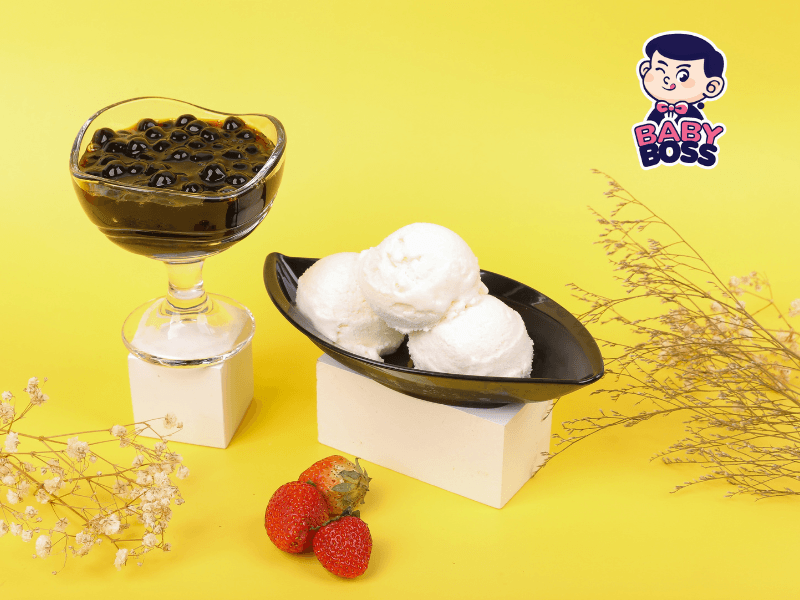
The preparation of Italian Gelato requires careful consideration of specific quantities, as failing to follow the carefully researched recipe correctly can significantly increase the risk of failure. Therefore, to produce a quality ice cream, you need to understand the standard Gelato-making process. Don’t hesitate to explore this dessert in greater detail in the article below!
Essential ingredients for making Gelato
To make delicious and refreshing Italian Gelato on hot summer days, you need to prepare the following ingredients:
- Fresh fruit or fruit jam (depending on the flavour)
- Water
- Milk
- Skimmed milk powder
- Sugar
The main ingredients for creating the finest Gelato include sugar, water, milk and skimmed milk powder. In addition, you can add flavourings, puréed fruit and more as desired to make the Gelato more appealing and sweetly aromatic.

Ingredients for making Gelato
A guide to making irresistibly delicious Gelato
Gelato has a low fat content, usually only from 0% to 8%, while ice cream has a higher fat content of from 15% to 18%. Because of this difference, Gelato does not freeze as hard as conventional ice cream, instead having a smooth texture and relatively low firmness. So how is this difference created during the production process? Let’s explore how to make Gelato at Baby Boss step by step below:
Step 1: Mixing
To carry out the mixing process smoothly, the first thing you need to do is select the right ingredients and measure them accurately according to the Gelato recipe. Then, place everything in the same bowl. During mixing, you must stir evenly and quickly to ensure that the mixture does not form lumps.
Step 2: Pasteurising the mixture
Pasteurisation plays an important role in controlling microorganisms and eliminating bacteria, particularly during the production of ice cream, milk and cream powder. In addition, pasteurisation helps reduce the number of psychrotrophic organisms and improve the moisture content of certain ingredients, such as protein and other stabilisers.

A guide to making Gelato
Step 3: Homogenising the mixture
This step helps ensure the uniformity of the ice cream mixture, forming a fat emulsion or reducing the size of the fat particles in the milk and cream powder. As a result, the mixture becomes thinner and easier to whip.
To carry out this homogenisation process, the temperature must be maintained at the pasteurisation level. If the temperature is too high, the mixture may break down and reduce the ability of the fat to aggregate. Furthermore, if this process takes place at a high temperature for an extended period, the mixture will become thick and set.
Step 5: Freezing the ice cream
Before starting the freezing process, you should add your preferred flavouring, puréed fruit or natural food colouring to the mixture to make the ice cream more appealing. Then, put the mixture through the freezing process.
This is an extremely important stage because it makes the ice crystals smaller, creating a supple and smooth ice cream structure. In addition, the freezer helps introduce air into the mixture, giving the ice cream an attractive light and airy texture.
Step 6: Hardening
Finally, after completing the freezing process, store the Italian Gelato in a freezer with the temperature maintained at around -18°C to -25°C. Storing it at this temperature will help extend the shelf life of the Gelato and keep it delicious and refreshing.

Italian Gelato – Irresistibly delicious
Important notes for making delicious Gelato with the authentic flavour
Making Gelato is a process involving many complex stages. Therefore, there are several important points you need to follow to ensure that the final product has the authentic delicious flavour, specifically:
1. Notes on ice cream temperature
The most important thing you should not overlook when making Gelato is paying attention to the temperature of the ice cream:
- Pasteurisation temperature: 70°C - 80°C.
- Ice cream storage temperature: -18°C to -25°C.
If the ice cream starts to melt, whip it again. Then, place it in the refrigerator until it freezes again. Finally, you can transfer it to the freezer for storage at a temperature from -18°C to -25°C.
2. Cleaning the equipment before making ice cream
If the equipment is not cleaned carefully, the ice cream may be affected by contamination from bacteria and germs, which can reduce its storage life and cause changes to its volume or surface. Therefore, before starting to make ice cream, the machinery must be thoroughly cleaned and dried. However, avoid using paper or cotton towels to clean the machine chamber, as they can easily leave behind dust and dirt. In addition, all tools used to scoop and contain the ice cream must also be cleaned and dried before use.

Important notes for making delicious Gelato with the authentic flavour
Comments